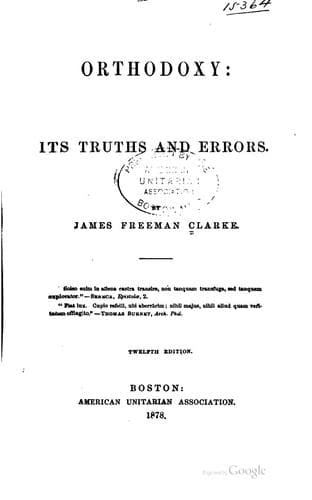
Orthodoxy: Its Truths And ErrorsClarke, James Freeman
Religion
Orthodoxy: Its Truths And Errors
Clarke, James Freeman
Unitarianism
If there were Judaism and Paganism in the early Church, they still, no
doubt, linger in our churches to-day. The Church Judaizes in this—that it
still puts forms above life. For example, the Roman Catholic Church
teaches that if you take a child, and put water upon him, repeating the
baptismal formula, and with the _intention_ of baptizing him, the child
becomes in that moment regenerate. If he had died the moment before, he
would have been damned forever in eternal torments; if he dies the moment
after, he will go to eternal bliss in heaven. Now, if an earthly parent
should cover his child’s body with camphene, and then set it on fire,
because somebody had not baptized it, we should say he was a very cruel
parent. But this conduct is attributed to the good God by the Roman
Catholic doctrine. Moreover, when an outward form is made thus essential,
when everlasting salvation or damnation depends on it, it behooves us to
know what it is. Baptism consists of three parts—the water, the formula,
and the intention of the baptizer. But as to the water, we may ask, _How
much_ is essential? Is it essential that there be enough to entirely
immerse the body? The Catholic Church replies, “_No_.” Is the aqueous
vapor always present in the air enough? It answers, “No, _that_ is _not_
enough.” At what precise point, then, between these two, does _enough_
begin, does baptism take place, and the child cease to be a child of
perdition, and become an heir of salvation? The Roman Catholic Church,
being obliged to answer this question, has answered it thus: There is no
baptism until water enough to _run_ is put on the child. A drop which will
not _run_, does not baptize him; a drop which will run, baptizes him. The
difference, then, between these two drops, is the difference to the child
between eternal damnation and eternal salvation.(70)
How does this sound by the side of the declaration of the apostle Paul—“He
is not a Jew who is one outwardly, neither is circumcision outward in the
flesh; but he is a Jew who is one inwardly, and circumcision is of the
heart”? Judaism, if anything, was an outward institution; Christianity, if
anything, is an inward life. And yet that which the apostle Paul said of
Judaism we hardly to-day would venture to say of Christianity. “He is not
a Christian who is one outwardly, neither is Christianity in outward
belief, profession, or aspect; but he is a Christian who is one inwardly.”
“O, no!” we say, “there must be a distinction. A man who does not believe
in the miracles, for example, may be a good man, but you must not call him
a Christian.” But he who follows Christ, we think, is a Christian. And as
Christ walks before mankind on the divine road of goodness, truth, love,
purity, he who walks on that road _cannot help being a follower_ of
Christ, whatever he may call himself.
Public-domain text, read in full here on John Shaqi.
Reviews
Reviews
No reviews yet
Be the first to share your thoughts on this work.
Elsewhere in the archive
Join the Discussion
Join the discussion
Sign in to leave a comment or review.
Sign InorCreate an account