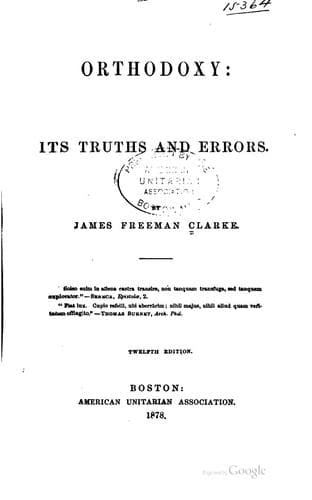
Orthodoxy: Its Truths And ErrorsClarke, James Freeman
Religion
Orthodoxy: Its Truths And Errors
Clarke, James Freeman
Unitarianism
One of the greatest evils of our churches is, that they are churches of
the clergy, not of the people. Our clergy are generally pure-minded,
well-intentioned men, less selfish and worldly than most men; but they are
not equal to the demands of their position. We take a young man, send him
to college, then to a theological school, where he studies his Greek very
faithfully, and learns to write sermons. He comes out, twenty-two years
old, a pleasing speaker, and is immediately settled and ordained over a
large long-established church. As he rises in the pulpit and looks down on
his congregation, one would think he would despair. What can he say to
them? He knows nothing of human nature, of its struggles and sins, its
temptations in the shop and the street. Men do not curse at him, nor try
to cheat him, nor entice him into bar-rooms, oyster-cellars,
billiard-rooms, and theatres. He cannot speak to men of their vices, their
stony and hard hearts, their utter unbelief, their crying selfishness, for
he knows nothing of it. He must speak of sin in the abstract, not of sin
in the concrete. If he did, what could he say? What weapons has he? The
sword of the Spirit is in his hands, but he has not tried it; he has no
confidence in it. The awful truths of the Bible, which smite the stoutest
sinner to the earth, these he might utter, if he dared; but he knows not
how. And yet he is the teacher of these gray-headed men, and their only
teacher. Had he gone out as Jesus sent his disciples, without purse or
shoes or two coats, and preached the gospel for ten years by the way-side,
in cottages, in school-houses, living hard, sleeping on the floor, seeing
men and women everywhere without disguise, and taking no thought
beforehand what to say, but leaning on God for his inspiration,—then might
he have learned how to say something weighty even to a great congregation.
Or if this poor boy were surrounded by a living active church, helping him
by advice, going with him into the house of sorrow, the haunt of sin,
kneeling with him by the sick couch and death-bed, and adding to his small
experience the whole variety and richness of theirs,—then might he be a
man of God, thoroughly furnished for every work.
Public-domain text, read in full here on John Shaqi.
Reviews
Reviews
No reviews yet
Be the first to share your thoughts on this work.
Elsewhere in the archive
Join the Discussion
Join the discussion
Sign in to leave a comment or review.
Sign InorCreate an account