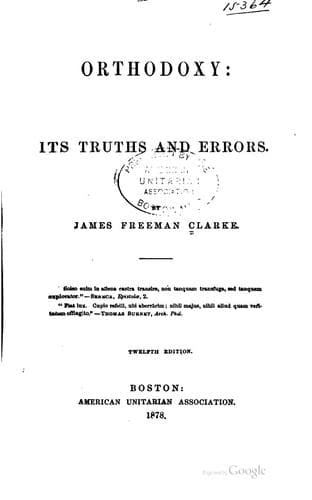
Orthodoxy: Its Truths And ErrorsClarke, James Freeman
Religion
Orthodoxy: Its Truths And Errors
Clarke, James Freeman
Unitarianism
It is possible to have a Church which shall be ready to teach and preach
the gospel, not to a few pew-holders only, but to the whole community.
Every child born in New England is taught the elements of secular
knowledge without money and without price. Are the waters of earthly
knowledge, then, so much more essential to the safety of the state than
the waters of life, that we cannot risk the chance of leaving any child
uninstructed in reading and writing, but may leave him untaught in the
gospel? It would seem to be possible, since we have free schools, to have
also free Churches, and so really to have, what we profess to maintain,
_Public Worship_! There is no such thing now as public worship. The
churches are not public places—each belongs to a private corporation of
pew-holders.
It is possible to have a Church which shall consider it its duty to obey
its Master’s first command, and “preach the gospel to every creature.” Its
mission shall be to go out into the highways and the hedges, to seek and
save the lost. It will regard the world as its field, and the whole
community as its sphere of labor—the whole community, according to its
needs, to be taught, helped, comforted, and cured by the gospel.
It is possible to have a Church which shall be united, not on ceremonies,
nor on a creed, but on study and labor, on loving and doing. The condition
of admission should be the purpose to get good and do good. They should
enter this school to learn, and not because they were already learned; to
become good, and not because they were already so.
It is possible to have a Church which shall make it its purpose to educate
the whole man—spirit, soul, and body; and not merely the spirit; to
present the human being to God perfect and entire, wanting nothing.
It is possible to have a Church which shall combine union and freedom. The
Roman Church, aiming at union, and neglecting freedom, has a union which
is no real union; which is an outward shell of conformity, without inward
unity of heart and thought. The Protestant Church, desiring freedom and
neglecting union, has a freedom which is not really freedom, being only
the outward liberty of tolerated opinions, but one in which free thought
is discouraged, and honest difference of opinion disallowed. Only by
combining in a living whole such antagonist needs, can either of these be
fully secured. Union without freedom is not union; freedom without union,
not freedom. There is no harmony in the juxtaposition of similar notes,
but in the concord of dissimilar ones. Difference without discord, variety
in harmony, the unity of the spirit with diversity of the letter,
difference of operation, but the same Lord, many members, but one
body,—this is very desirable, and wholly possible.
Public-domain text, read in full here on John Shaqi.
Reviews
Reviews
No reviews yet
Be the first to share your thoughts on this work.
Elsewhere in the archive
Join the Discussion
Join the discussion
Sign in to leave a comment or review.
Sign InorCreate an account