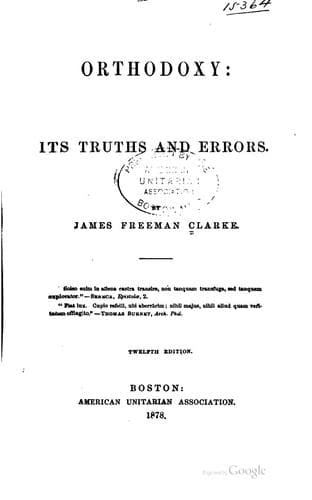
Orthodoxy: Its Truths And ErrorsClarke, James Freeman
Religion
Orthodoxy: Its Truths And Errors
Clarke, James Freeman
Unitarianism
The day is coming in which our dogmatic Churches, formal Churches,
sentimentally pious Churches, and professedly liberal Churches, shall be
all taken up into something higher and better. The very discontent which
prevails everywhere announces it. It is the working of the leaven—mind
agitating the mass. In Protestant countries there is a tendency to Rome;
but in Roman Catholic countries an equal or greater tendency to
Protestantism. Orthodoxy tends to Liberal Christianity. Liberal
Christianity tends to Orthodoxy. Each longs for its opposite, its
supplement, its counterpart. It is a movement towards a larger liberty and
a deeper life.
CHAPTER XVI. THE TRINITY.
§ 1. Definition of the Church Doctrine.
“The fundamental formula for the doctrine of the Trinity, as defined by
the Church,” says Twesten,(72) “is, that in one divine essence or nature
there are three persons, distinguished from each other by certain
characteristics, and indivisibly participating in that one nature.” The
“Augsburg Confession,” says, in like manner, “three persons in one
essence.”(73) So the “Gallic Confession,” and other Church Confessions,
which say almost the same thing in the same words.(74)
The explanations given to these phrases vary indefinitely. Nitzsch (System
d. Christ. Lehre, § 80) says, “We stand related in such a way, with all
our Christian experience (Gewerdensein und Werden), to the one, eternal,
divine essence, who is love, that in the Son we adore love as mediating
and speaking, in the spirit as fellowship and life, in the Father as
source and origin.” Schleiermacher considers this doctrine as not any
immediate expression of the Christian consciousness, and declares that
“our communion with Christ might be just the same if we knew nothing at
all of this transcendent mystery.” Hase says,(75) “This Church dogma
always has floated between Unitarianism, Tritheism, and Sabellianism,
asserting the premises of all three, and denying their conclusions only by
maintaining the opposite.”
Public-domain text, read in full here on John Shaqi.
Reviews
Reviews
No reviews yet
Be the first to share your thoughts on this work.
Elsewhere in the archive
Join the Discussion
Join the discussion
Sign in to leave a comment or review.
Sign InorCreate an account