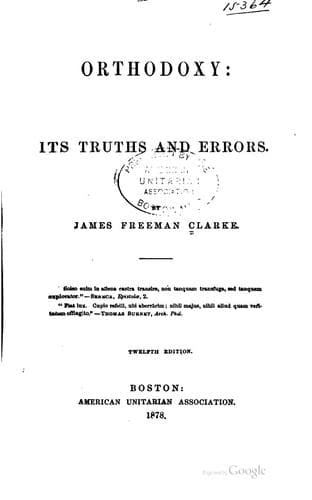
Orthodoxy: Its Truths And ErrorsClarke, James Freeman
Religion
Orthodoxy: Its Truths And Errors
Clarke, James Freeman
Unitarianism
22. The Holy Spirit is from the Son and the Father; not created, nor
begotten, but _proceeding_.
23. Therefore there is one Father, and not three; one Son, and not three;
one Holy Spirit, and not three.
24. And in this Trinity there is none before or after, none greater or
less, but all three Persons are coeternal and coequal.
25. So that everywhere we must adore the Unity in Trinity, and the Trinity
in Unity.
26. Whoever, therefore, would be saved, must think thus of the Trinity.
§ 2. History of the Doctrine.
In the Christian Church, the history of this doctrine is interesting and
important. Some sort of Triad, or Trinity, existed in very early times,
although the Orthodox form was not established until later.
At first, the prevailing doctrine is that of subordination; that is, that
the Son and the Spirit are inferior to the Father. But, as the Son and the
Spirit were also called divine, those who thought thus were accused of
believing in three Gods.(83) Some then said, that the Father was alone
divine; and these were called Monarchians. Others, wishing to retain the
divinity of the Son and Spirit, and yet to believe in one God, said that
the _divinity_ in the Father, in the Son, and in the Spirit, was
essentially the same, but that the divinity of the Father was the fountain
from which that of the Son and Spirit was derived. This was fixed as
Orthodox at the Council of Nice, A.D. 325, and was the beginning of
Orthodoxy in the Church. It was a middle course between Scylla and
Charybdis, which were represented on the one side by Arius, who maintained
that the Son was created out of nothing; and by Sabellius on the other
hand, who maintained that the Son was only a mode, manifestation, or name
of God; God being called the Father, as Creator of the world; called Son,
as Redeemer of the world; and Spirit, as Sanctifier of the world. The
Council of Nice declared that the Son was not a manifestation of God, as
Sabellius said, nor a creation by God, as Arius said, but a derivation
from God.(84) Just as the essence of the fountain flows into the stream
derived from it, so the essence of the Father flows into the Son, who is
derived from him. Here, then, we have the three formulas of the early
Church—that of Arius, who says, “The Son was created by the Father, and is
inferior to him;” that of Sabellius, who says, “The Father, Son, and
Spirit, are manifestations of God, and the same essence;” and Orthodoxy,
as the Council of Nice, trying to stand between them, and saying, “The Son
is derived from the Father, and is of the same essence with him.”
Public-domain text, read in full here on John Shaqi.
Reviews
Reviews
No reviews yet
Be the first to share your thoughts on this work.
Elsewhere in the archive
Join the Discussion
Join the discussion
Sign in to leave a comment or review.
Sign InorCreate an account