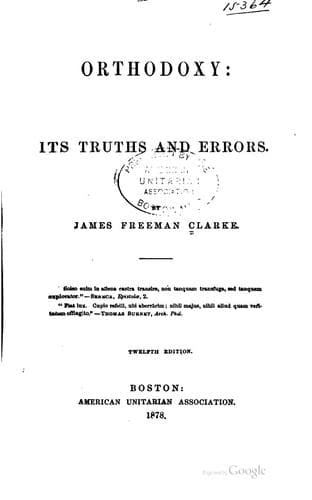
Orthodoxy: Its Truths And ErrorsClarke, James Freeman
Religion
Orthodoxy: Its Truths And Errors
Clarke, James Freeman
Unitarianism
The Church, ever since, has been like a ship beating against head winds
between opposing shores. It has stood on one tack to avoid Arianism or
Tritheism, till it finds itself running into Sabellianism; then it goes
about, and stands away till it comes near Arianism or Tritheism again.
Unitarianism is on both sides: on one side in the form of one God, with a
threefold manifestation of himself; on the other side in the form of a
Supreme God, with the Son and Spirit subordinate. It has always been very
hard to be Orthodox; for, to do so, one must distinguish the Persons, and
yet not divide the substance, of the Deity. In keeping the three Persons
distinctly separate, there was great danger of making three distinct Gods.
On the other hand, if one tried to make the Unity distinct, there was
danger that the Persons would grow shadowy, and disappear.
The heaviest charge against the Church doctrine of the Trinity is, that,
driven to despair by these difficulties, it has at last made Orthodoxy
consist, not in any sound belief, but only in sound phrases. It is not
believing anything, but saying something, which now makes a man Orthodox.
If you will only use the _word_ “Trinity” in any sense, if you will only
call Christ God in any sense, you are Orthodox.
§ 3. Errors in the Church Doctrine of the Trinity.
The errors in the popular view concerning the Trinity, as it is at present
held, appear to be these:—
1. _The Trinity is held as a mere dogma_, or form of words, not as a
reality. It is held in the letter, not in the spirit. There is no power in
it, nor life in it; and it is in no sense an object of faith to those who
accept it. They do not believe it, but rather believe that they ought to
believe it. There are certain texts in Scripture which seem to assert it,
certain elaborate arguments which appear convincing and irrefutable. On
the strength of these texts and these arguments, they believe that they
ought to believe it. But it is a matter of conscience, not of heart; of
logic, not of life; of law, not of love. It is not held as a Christian
doctrine ought to be held, with the heart; but only philosophically, with
the head. If it should cease to be preached for a few years in Orthodox
pulpits, it would cease to be believed; it would drop out of the faith, or
rather out of the creed, of the community. Unitarianism has extended
itself, without being preached, from the simple reading of the Bible. But
Trinitarianism cannot be trusted to its own power. It has no hold on the
heart. Here, in Massachusetts, the ministers left off preaching the
Trinity, and the consequence was, that the people became Unitarian.
Unitarianism in New England was not diffused by preaching: it came of
itself, as soon as the clergy left off preaching the Trinity. This shows
how worthless, empty, and soulless the doctrine was and is. Instead of
this formal doctrine, we want something vital.
Public-domain text, read in full here on John Shaqi.
Reviews
Reviews
No reviews yet
Be the first to share your thoughts on this work.
Elsewhere in the archive
Join the Discussion
Join the discussion
Sign in to leave a comment or review.
Sign InorCreate an account