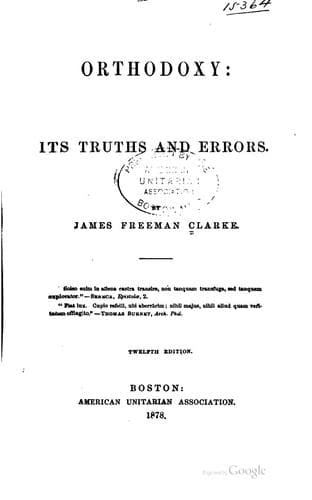
Orthodoxy: Its Truths And ErrorsClarke, James Freeman
Religion
Orthodoxy: Its Truths And Errors
Clarke, James Freeman
Unitarianism
3. _It is also charged against the doctrine of the Trinity, __“__that it
is a contradiction in terms, and therefore essentially incredible.__”_ To
this it is replied, that it would be a contradiction if God were called
Three _in the same sense_ in which he is called One; but not otherwise.
The answer is perfectly satisfactory; and we therefore proceed to ask, In
what sense is he called Three, and in what sense is he called One? The
answer is, The Unity is of essence, or substance: the Trinity is of
persons. This answer, again, is satisfactory, provided we know what is
meant by these two terms. But the difficulty is to know what is meant by
the word “person.” We are expressly informed, that this term is not used
in its usual sense; for, if it were, it would divide the essence, and
three Persons would be the same as three Gods. On the other hand, we are
told that it means more than the three characters or manifestations. Here
lies the difficulty, and the whole of the rational difficulty, in the
doctrine of the Trinity. It is all on the side of the Triad. When we ask,
What do you mean by “the three”? there can be given but three answers,—two
of them distinct, and one indistinct. These answers are, (1.) We mean
three somethings, which we cannot define; (2.) We mean three Persons, like
Peter, James, and John; (3.) We mean three manifestations, characters, or
modes of being. Let us consider these three answers.
(_a._) “The three Persons are three somethings, which cannot be defined.
It is a mystery. It is above reason. There is mystery in everything, and
there must be mystery in the Deity.” So Augustine said, long ago, “We say
three Persons, not because we have anything to say, but because we want to
say something.”(85) But if one uses the phrase “three Persons,” and
refuses to define it positively, merely defining it negatively, saying,
“It does not mean this, and it does not mean that, and I don’t know what
it does mean,” he avoids, it is true, the difficulties, and escapes the
objections; but he does it by giving up the article of faith. No one can
deny that there _may be_ three unknown distinctions in the divine nature;
but no one can be asked to believe in them, till he is told what they are.
To say, therefore, that the Trinity is a mystery, is to abandon it as an
article of faith, and make of it only a subject of speculation. We avoid
the contradiction; but we do it by relinquishing the doctrine.
Public-domain text, read in full here on John Shaqi.
Reviews
Reviews
No reviews yet
Be the first to share your thoughts on this work.
Elsewhere in the archive
Join the Discussion
Join the discussion
Sign in to leave a comment or review.
Sign InorCreate an account