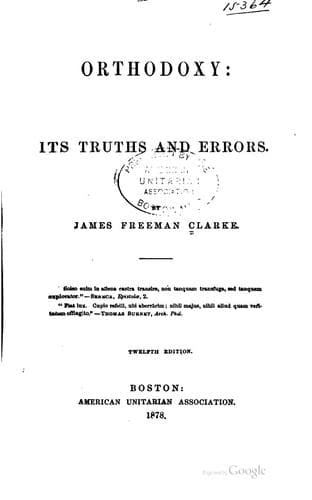
Orthodoxy: Its Truths And ErrorsClarke, James Freeman
Religion
Orthodoxy: Its Truths And Errors
Clarke, James Freeman
Unitarianism
2. _Another objection to the present form of the Trinity is, that it is
not only scholastic, or purely intellectual, but that it is also
negative._ It is not even a positive doctrine. It is often charged against
Unitarianism, that it is a mere negation; and, in one sense, the charge is
well founded. Unitarianism is a negation, so far as it is a mere piece of
reasoning against Orthodoxy; but, as asserting the divine Unity, it is
very positive, But the doctrine of the Trinity _is_ a mere negation, as it
is usually held; because it is an empty form of denial. It only can be
defined or expressed negatively. The three Persons are not substances, on
the one hand; nor qualities, on the other hand. It is not Sabellianism,
nor is it Arianism. Every term connected with the Trinity has been
selected, not to express a truth, but to avoid an error. The term “one
essence” was chosen in order to exclude Arianism; the term “three
Persons,” or subsistences, was chosen in order to avoid Sabellianism.
Because the doctrine is thus a negation, it has failed of its chief use.
It has become exclusive; whereas, when stated truly, as a positive truth,
it would become inclusive. Rightly stated, it would bind together all true
religion in one harmonious whole, comprehending in its universal sweep
everything true in natural religion, everything true in reason, and
uniting them in vital union, without discord and without confusion. Every
manifestation which God has made of himself in nature, in Christ, and in
the human soul, would be accepted and vitally recognized by Christianity,
which comes, not to destroy, but to fulfil. The doctrine of the Trinity
would be the highest form of reconciliation or atonement,—reconciling all
varieties in one great harmony; reconciling the natural and supernatural,
law and grace, time and eternity, fate and freedom.
But, before illustrating this, we must consider further some of the
objections to the common form of the doctrine.
Public-domain text, read in full here on John Shaqi.
Reviews
Reviews
No reviews yet
Be the first to share your thoughts on this work.
Elsewhere in the archive
Join the Discussion
Join the discussion
Sign in to leave a comment or review.
Sign InorCreate an account