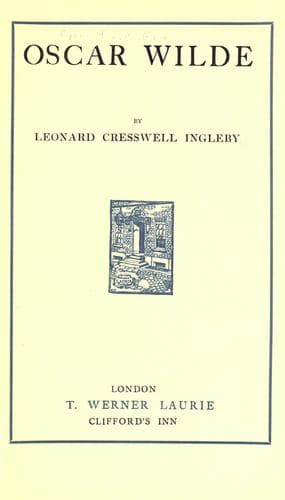
Authors, Irish -- 19th century -- Biography; Wilde, Oscar, 1854-1900
"The Florentine Tragedy," as already indicated, is a brief one-act
drama. There are only three characters: an old Florentine merchant, his
beautiful wife, and her lover. The simple plot may be briefly indicated.
The merchant, arriving suddenly at his home after a short absence, finds
his wife and his rival in her affections together at supper. He makes a
pretence at first of being profoundly courteous, and the ensuing
conversation (as need hardly be said) is pointed, epigrammatic, and
witty. Then the old man gradually leads up to what, it becomes obvious,
had been his fixed purpose from the beginning. He draws the lover into a
duel. This takes place in the presence of the wife, who, indeed, holds
aloft a torch in order that the two swordsmen may fight the more easily.
The contest waxes fiercer, and the swords are exchanged for daggers.
The wife casts the torch to the ground as the two men close with each
other, and the younger one falls mortally wounded. The ending is
dramatic. The infuriated husband turns to his shrinking wife and
exclaims, "Now for the other!" The woman, in mingled remorse and fear,
says, "Why did you not tell me you were so strong?" And the husband
rejoins, "Why did you not tell me you were so beautiful?" As the curtain
descends, the couple, thus strangely reconciled, fall into each other's
arms.
The character of outstanding importance, of course, is that of the old
merchant. According to those who have studied the play, he is a
strikingly effective figure, most cleverly and delightfully drawn. In
the opinion of Mr Moore the part is one that would have fitted Sir Henry
Irving excellently well. The action of the drama occupies less than
half-an-hour.
In this connection it may be well to recall the testimony of an Irish
publisher quoted by Mr Sherard in his "Life of Oscar Wilde." This
gentleman attended the sale of the author's effects in Tite Street, and
in a room upstairs found the floor thickly strewn with letters addressed
to the quondam owner of the house and a great quantity of his
manuscripts. He concluded that as the various pieces of furniture had
been carried downstairs to be sold their contents had been emptied out
on to the floor of this room. Presently a broker's man came up to him
and inquired what he was doing in the room, and on his replying that
finding the door open he had walked in, the man said, "then somebody has
broken open the lock, because I locked the door myself." This gentleman
surmises that it was from this room that various manuscripts that have
never been recovered were stolen!
When the piece was produced by the Literary Theatre Club it suffered
from inadequate acting. Mr George Ingleton was quite overweighted by the
part of Simone, the Florentine merchant. It is a part that requires an
Irving to carry it through, or, at anyrate, an actor of great
experience, and for anyone else to attempt it is a piece of daring which
can only result in failure.
Public-domain text, read in full here on John Shaqi.
Reviews
Reviews
No reviews yet
Be the first to share your thoughts on this work.
Elsewhere in the archive
Join the Discussion
Join the discussion
Sign in to leave a comment or review.
Sign InorCreate an account