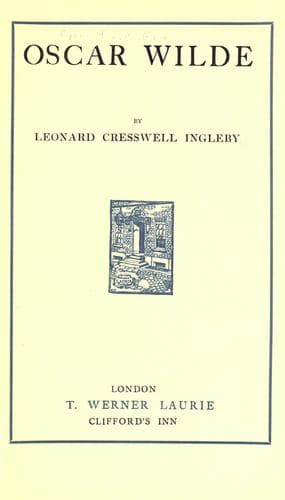
Authors, Irish -- 19th century -- Biography; Wilde, Oscar, 1854-1900
If a keynote were wanted to Oscar Wilde's verse it might be found in a
couple of stanzas by the poet whose work perhaps had the greatest share
in moulding his ideas and fashioning his style. Charles Baudelaire, with
all his love of the terrible and the morbid, was an incomparable
stylist, and in these lines has almost formulated a creed of art.
"La Nature est un temple où de vivants piliers
Laissent parfois sortir de confuses paroles;
L'homme y passe à travers des forêts de symboles
Qui l'observent avec des regards familiers.
Comme de longs échos qui de loin se confondent
Dans une ténébreuse et profonde unité,
Vaste comme la nuit et comme la clarté,
Les parfums, les couleurs et les sons se répondent."
We can picture to ourselves the young Oxford student studying these
lines over and over again till they had become part and parcel of
himself.
Wilde himself has left it on record that he "cannot imagine anyone with
the smallest pretensions to culture preferring a dexterously turned
triolet to a fine imaginative ballad." In the majority of his poems, the
beauties of nature, flowers, the song of birds and the music of running
water are introduced either incidentally or as the _leit motif_. In
fact, he was responsible for the dictum that what English poetry has to
fear is not the fascination of dainty metre or delicate form, but the
predominance of the intellectual spirit over the spirit of beauty.
That the expression of the beautiful need not necessarily be simple was
one of his earliest contentions. "Are simplicity and directness of
utterance," he asks, "absolute essentials for poetry?" and proceeds to
answer his own question. "I think not. They may be admirable for the
drama, admirable for all those imitative forms of literature that claim
to mirror life in its externals and its accidents, admirable for quiet
narrative, admirable in their place; but their place is not everywhere.
Poetry has many modes of music; she does not blow through one pipe
alone. Directness of utterance is good, but so is the subtle recasting
of thought into a new and delightful form. Simplicity is good, but
complexity, mystery, strangeness, symbolism, obscurity even, these have
their value. Indeed, properly speaking, there is no such thing as Style;
there are merely styles, that is all."
There we have a clear, concise and catholic statement of his literary
creed, and none other was to be expected from one to whom Baudelaire,
Poe, Keats, and Rossetti were so many masters whose influence was to be
carefully cultivated and whose methods were worthy of imitation and
study. His views on the subject of simplicity in verse should be read by
all who desire to understand his method and do justice to his work.
Public-domain text, read in full here on John Shaqi.
Reviews
Reviews
No reviews yet
Be the first to share your thoughts on this work.
Elsewhere in the archive
Join the Discussion
Join the discussion
Sign in to leave a comment or review.
Sign InorCreate an account