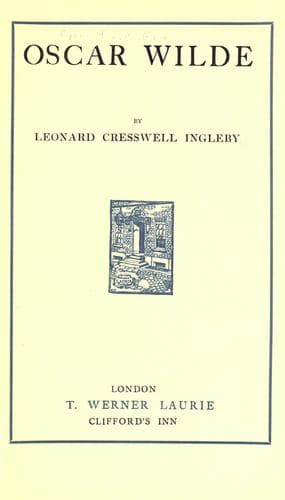
Authors, Irish -- 19th century -- Biography; Wilde, Oscar, 1854-1900
"We are always apt to think," he wrote, "that the voices which sang at
the dawn of poetry were simpler, fresher, and more natural than ours,
and that the world which the early poets looked at, and through which
they walked, had a kind of poetical quality of its own, and could pass,
almost without changing, into song. The snow lies thick now upon
Olympus, and its scarped sides are bleak and barren, but once, we fancy,
the white feet of the Muses brushed the dew from the anemones in the
morning, and at evening came Apollo to sing to the shepherds in the
vale. But in this we are merely lending to other ages what we desire, or
think we desire, for our own. Our historical sense is at fault. Every
century that produces poetry is, so far, an artificial century, and the
work that seems to us the most natural and simple product of its time is
probably the result of the most deliberate and self-conscious effort.
For nature is always behind the age. It takes a great artist to be
thoroughly modern."
"Ravenna," the poem with which Oscar Wilde won the Newdigate Prize, we
find to be far above the average of such effusions, though possessing
most of the faults inherent in compositions of this kind. Grace and
even force of expression are not wanting, with here and there a pure
strain of sentiment and thought, and a keen appreciation of the beauties
of nature. Ever and anon we come across some sentence, some _tournure de
phrase_ which might belong to his later work, as for instance--
"The crocus bed (that seems a moon of fire
Round-girdled with a purple marriage-ring)."
But for the most part the poem is rather reminiscent of "Childe Harold's
Pilgrimage," and is chiefly interesting by reason of the promise it
holds forth.
The poems published in 1881 are preceded by some dedicatory verses
addressed to his wife which are characterised by great daintiness and
simplicity, instinct with tender affection and chivalrous homage.
"Helas," which forms a sort of preface to the collection, is chiefly
interesting on account of the prophetic pathos of the lines:
"Surely there was a time I might have trod
The sunlit heights, and from life's dissonance
Struck one clear chord to reach the ears of God."
"Ave Imperatrix" will come as a surprise to those unacquainted with
Wilde's works. Most people would have thought the author of "Dorian
Gray" the last man in the world to write a stirring patriotic poem which
would not be out of place in a collection of Mr Kipling's works. A copy
of _The World_ containing this poem found its way to an officer in Lord
Robert's force marching on Candahar, and evoked the enthusiasm and
admiration of the whole mess. As a proof of the author's originality and
care in the choice of similes he purposely discards the modern heraldic
device of the British lion for the more correct and ancient leopards,
as:
Public-domain text, read in full here on John Shaqi.
Reviews
Reviews
No reviews yet
Be the first to share your thoughts on this work.
Elsewhere in the archive
Join the Discussion
Join the discussion
Sign in to leave a comment or review.
Sign InorCreate an account