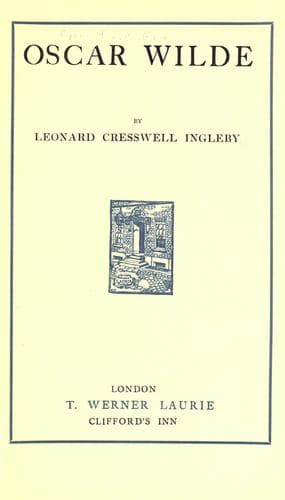
Authors, Irish -- 19th century -- Biography; Wilde, Oscar, 1854-1900
order of all things is surely sustained and vitally expanded, and
although with strange vacillation, in the eyes of the watcher, the
morning cometh, and also the night, there is no hour of human existence
that does not draw on towards the perfect day."
For our own part let us examine a little into the relation between art
and morality for ourselves.
When we hear it asserted that morality has nothing to do with art and
that moral considerations are quite beside the mark in æsthetic
criticism and judgment, such a statement is simply equivalent to saying
that actual life has nothing to do with art. The main demand that we can
make from art of all kinds is the demand of truth. Truth is beauty, and
beauty is truth. By truth in this connection we mean that higher and
more ideal truth which is inherent in the realities of things and
contained by them, but which is brought out, explained, made credible,
and visible by the artist in this or that sphere of art, and through the
process of his art purified from the accidental obscurities which cloud
it and hide it in the realm of actual life. If we are to demand truth
from the artist, and let us always remember, as Keats realised so
strongly, that in demanding truth we demand beauty also, we must insist
that the artist must give us nothing in which a false psychology
obtains, must, for example, paint no passions that do not occur in
actual life. It is, therefore, equally necessary, on a logical
conclusion, that when the subject of a work of art requires it, the
moral should be represented as it really is--that is, according to its
truth--and that the moral law should not be misrepresented. If we
require of the artist that he should give a vivid representation of the
illusions of human life, of the struggles and rivalries of men for
objects and ends of imaginary value, we must equally demand of the
artist that he should know and be capable of describing that which alone
has true and absolute value in human life. Surely it is a truism that
every drama from beginning to end contains a moral. It is a lie that art
is immoral or can by its very nature ever be so. To say so, to pretend
that art has a separate existence, is to say something which even the
most brilliant paradox cannot prove and which immediately suggests to
the mind of the thinking man an apologia or reason for licence of
personal conduct. As a great German writer on æsthetics and the relation
to the ethics has said, all human actions do of necessity presuppose a
norm, a rule to which they conform, or from which they depart; and there
is nothing which can be represented, whether as criminal or as
ridiculous, or as an object of irony, otherwise than under this
assumption. Hence every artist enforces some kind of morality, and
morality accordingly becomes of chief moment for æsthetic judgment.
Public-domain text, read in full here on John Shaqi.
Reviews
Reviews
No reviews yet
Be the first to share your thoughts on this work.
Elsewhere in the archive
Join the Discussion
Join the discussion
Sign in to leave a comment or review.
Sign InorCreate an account