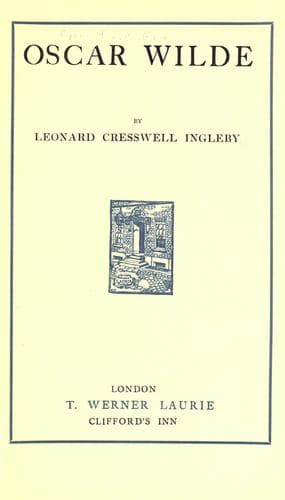
Authors, Irish -- 19th century -- Biography; Wilde, Oscar, 1854-1900
Aristotle himself, from whom Oscar Wilde frequently quotes, and
incidentally from whose poetics he attempts, by means of brilliant
paradox, to infer an attitude which is not really there, has pointed out
that art is a means of purification. If the morality of a work of art is
false and wrong, if the artist is either ignorant of the subject with
which he deals or deliberately misrepresents the morality of it, then
his work is viewed merely as a work of art--and therefore as a thing
whole and complete in itself--is a failure in art. In many respects it
may have æsthetic excellence, but as a complete thing, as a work of art,
it must inevitably fail.
Sibbern in his "Æsthetik" tells us very sanely and wisely that art need
not be limited by choice of subject, but depends for its artistic
qualities upon the attitude of the artist in dealing with it.
That art must not be limited by choice of subject is a great point of
Oscar Wilde's own philosophy, and here he is perfectly sound. But he
goes further in his paradoxical view, and shows that the artist must
hold no brief for either good or evil, and that the excellence of a work
of art depends entirely upon the skill of presentation.
The German student, on the contrary, writes:
"There are dramas in which the moral element is not brought into
special prominence, but just hovers above the surface, and which
yet have their poetic value. What must, however, be absolutely
insisted on is, that the artistic treatment should never insult
morality. We do not mean that art must not represent the immoral as
well as the moral, for this is, on the contrary, indispensable, if
art is truly to reflect life as it is. But immorality must not
infect and be inherent in that view of life and those opinions
which the poet desires by his work to promulgate; for then he would
injure morality, and violate that moral ideal to which all human
life, and therefore art itself, must be subordinated. Plays and
novels which depict virtue as that mere conventionality and
Philistinism which is but an object of ridicule, or which hold up
to our admiration false and antinomian ideals of virtue,
representing _e.g._, the sentimentality of a so-called good heart
as sufficient to justify the most scandalous moral delinquencies or
'free genius' as privileged to sin, which paint vice in attractive
and seductive colours, portraying adultery and other
transgressions as very pardonable, and, under certain
circumstances, amiable weaknesses, and which by means of such
delineations bestow absolution on the public for sins daily
occurring in actual life--such plays and novels are unworthy of
art, and are as poison to the whole community.
Public-domain text, read in full here on John Shaqi.
Reviews
Reviews
No reviews yet
Be the first to share your thoughts on this work.
Elsewhere in the archive
Join the Discussion
Join the discussion
Sign in to leave a comment or review.
Sign InorCreate an account