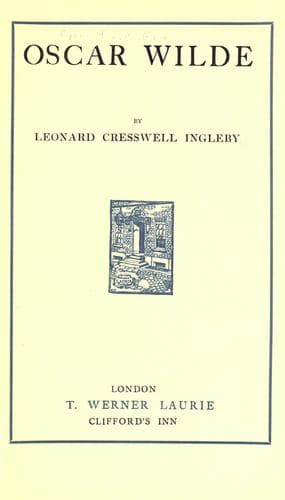
Authors, Irish -- 19th century -- Biography; Wilde, Oscar, 1854-1900
His landlord stated that towards the end it became very difficult for
Wilde to write at all. "He used to whip himself up with cognac. A litre
bottle would hardly see him through the night. And he ate little. And he
took little exercise. He used to sleep till noon, and then breakfast,
and then sleep again till five or six in the evening."
This is enough. I have said as little as can well be said. But let us
remember the frightful and crushing disabilities under which Wilde
suffered. Who is there who dare cast a stone? His death came as a happy
release, and it was sordid and dreadful enough to complete the grim
tragedy of his life without deviation from its completeness. True, an
attached friend was by him at the end. True, the offices of the Holy
Catholic Church lightened his passing. Yet, nevertheless, there was an
abiding and sinister gloom about all his last hours. Details can be
found in other places. "How Oscar Wilde died" was a journalistic
sensation at the time.
I will simply quote the words of a French critic, who, after the end,
went to pay his last sad duties to the shell which had held the poet's
soul: "... The hotel in which he died was one of those horrible places
which are called in the popular papers 'Houses of Crime.' A veritable
Hercules of a porter led me through a long, evil-smelling corridor. At
last the odour of some disinfectant struck my nostrils. An open door. A
little square room. I stood before the corpse. His whitish, emaciated
face, strangely altered through the growth of a beard after death,
seemed to be lost in profound contemplation. A hand, cramped in agony,
still clutched the dirty bed cloth. There was no one to watch by his
body. Only much later they sent him some flowers. The noise of the
street pierced the thin walls of the building. A stale odour filled the
air. Ah, what loneliness, what an end!"
If I have quoted this ugly and vulgar picture of the poet's body in the
sordid room I have done so with intention.
It is in the contemplation of such scenes as this that our minds and
hearts are uplifted from the material to the supreme hope of all of us.
The man who had suffered and sinned and done noble things in this world
had gone away from it. Doubtless, when the Frenchman with his prying
eyes and notebook was gloating over the material sensation of the scene,
the soul of the poet was hearing harmonies too long unknown to it, and
was beginning to undergo the Purification.
_Requiescat._
* * * * *
Public-domain text, read in full here on John Shaqi.
Reviews
Reviews
No reviews yet
Be the first to share your thoughts on this work.
Join the Discussion
Join the discussion
Sign in to leave a comment or review.
Sign InorCreate an account