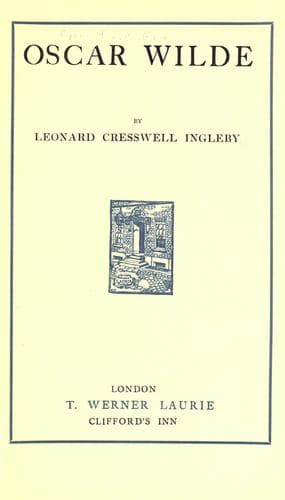
Authors, Irish -- 19th century -- Biography; Wilde, Oscar, 1854-1900
When Mr George Alexander produced "Lady Windermere's Fan" at the St
James's Theatre, in the spring of 1892, it created an unprecedented
furore among all ranks of the playgoing public, and placed the author at
once upon a pedestal in the Valhalla of the Drama; not on account of the
plot, which was frankly somewhat _vieux jeu_, nor yet upon any striking
originality in the types of the personages who were to unravel it, but
upon the sparkle of the dialogue, the brilliancy of the epigrams, a
condition of things to which the English stage had hitherto been
entirely unaccustomed. The author was acclaimed as a playwright who had
at last succeeded in clothing stagecraft with the vesture of literature,
and with happy phrase and nimble paradox delighted the minds of his
audience. What promise of a long succession of social comedies,
illuminated by the intimate knowledge of his subject that he so entirely
possessed, was held out to us! Here was a man who treated society as it
really exists; who was himself living in it; portraying its folk as he
knew them, with their virtues and vices coming to them as naturally as
the facile flow of their conversation; conversation interlarded with no
stilted sentences, no well- (or ill-) rounded periods, but such as that
which falls without conscious effort from the lips of people who, in
whatever surroundings they may be placed, are, before all things, and at
all times, thoroughly at their ease. It may be objected that people in
real life, even in the higher life of the Upper Ten, do not habitually
scatter sprightly pleasantries abroad as they sit around the
five-o'clock tea-table. That Oscar Wilde made every personage he
depicted talk as he himself was wont to talk. _Passe encore._ The real
fact remains that he _knew_ the social atmosphere he represented, had
breathed it, and was familiar with all its traditions and mannerisms. He
gave us the _tone_ of Society as it had never before been given. He was
at home in it. He could exhibit a ball upon the stage where real ladies
and gentlemen assembled together, quite distinct from the ancient
"Adelphi guests" who had hitherto done yeoman's service in every form of
entertainment imagined by the dramatist. The company who came to his
great parties were at least _vraisemblables_, beings who conducted
themselves as if they really might have been there. And so it was in
every scene, in every situation. His types are drawn with the pen of
knowledge, dipped in the ink of experience. That was his secret, the
keynote of his success. And with what power he used it the world is now
fully aware. It is not too much to say that Oscar Wilde revolutionised
dramatic art. Henceforth it began to be understood that the playwright
who would obtain the merit of a certain plausibility must endeavour to
infuse something of the breath of life into his creations, and make them
act and talk in a manner that was at least possible.
Public-domain text, read in full here on John Shaqi.
Reviews
Reviews
No reviews yet
Be the first to share your thoughts on this work.
Join the Discussion
Join the discussion
Sign in to leave a comment or review.
Sign InorCreate an account