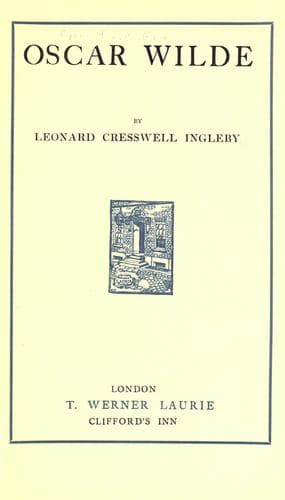
Authors, Irish -- 19th century -- Biography; Wilde, Oscar, 1854-1900
It is well-nigh impossible, under the existing conditions of the theatre
in England, to form any just appreciation of the dramatist's work at
all. A novel may be read at any time, but a play depends on the caprice
of a manager to "present" it or not, as suits his commercial
convenience. Happily for us the comedies of Oscar Wilde are printed and
published, and can be enjoyed equally in the study as in the stalls. We
must go back to Congreve and Sheridan to find a parallel. It is the
triumph of the _littérateur_ over the histrionic hack, the man whose
volumes are taken down from the shelves where they repose, again and
again, and require no adventitious aid of scenery and costume to enhance
the pleasure they afford. Albeit that the habit of reading plays is not
particularly an English one. The old Puritan feeling that all things
theatrical were tainted with more or less immorality still clings to
many a mind. Emotion is yet looked upon with suspicion, and as the
theatre is the hotbed of emotion it is even now regarded in some
quarters as a dangerous, if exciting, pleasure-ground. Sober-minded folk
prefer rather to take their doses of love tales in the form of the
novel, however inexpert, than in that of the play, however masterly it
may be. Let an author put to the vote his appeal to his public through
their eyes or their ears, it will be found that the eyes have it. They
prefer to stop at home and read, as they consider, seriously, than to go
abroad and listen to what they hold to be, trivialities. Oscar Wilde
has, in great measure, been instrumental in putting these illiberal
views to flight. Men and women are now to be found in the theatre when
his pieces are represented who not so long ago pooh-poohed the drama
from an intelligent standpoint. He has turned attention to the fact that
the dramatic method of telling a story may be made as intellectually
interesting as in the best-written romances of the novelist. He brought
to bear upon his work a singular power of observation, a fine
imagination, a unique wit, and above all, and beneath all, an extensive
knowledge of human life, and human character. Plays imbued with all
these qualities were bound to make their mark. He knocked away the
absurd conventions, the stereotyped phrases of the stage as he knew it.
He placed on it living people in the place of mechanical puppets, and by
his happy inspiration created a new order in the profession of
dramaturgy.
Public-domain text, read in full here on John Shaqi.
Reviews
Reviews
No reviews yet
Be the first to share your thoughts on this work.
Join the Discussion
Join the discussion
Sign in to leave a comment or review.
Sign InorCreate an account