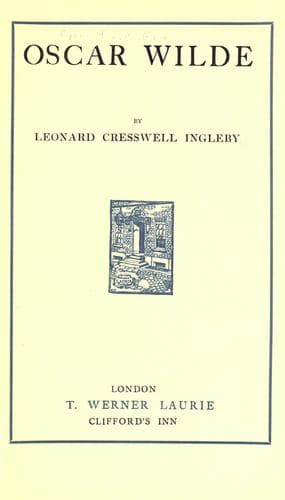
Authors, Irish -- 19th century -- Biography; Wilde, Oscar, 1854-1900
_Mrs Erlynne._ Thank you.
(_Exit Parker. The music in the ballroom stops._)
Gone out of her house! A letter addressed to her husband!
(_Goes over to bureau and looks at letter. Takes it up and lays it
down again with a shudder of fear._)
No, no! it would be impossible! Life doesn't repeat its tragedies
like that! Oh, why does this horrible fancy come across me? Why do
I remember now the one moment of my life I most wish to forget?
Does life repeat its tragedies?
(_Tears letter open and reads it, then sinks down into a chair with
a gesture of anguish._)
Oh, how terrible! the same words that twenty years ago I wrote to
her father! And how bitterly I have been punished for it! No; my
punishment, my real punishment is to-night, is now!
I have quoted these two episodes from the second act to demonstrate how
equal was the playwright to the exigencies of his art. But it is in the
third act, laid in Lord Darlington's rooms, that he reaches the level of
high dramatic skill. First, in the scene between the mother and
daughter, written with extraordinary power and pathos, and later on,
when each of the women are hidden, the "man's scene" which ranks with
the famous club scene in Lord Lytton's "Money." The _blasé_ and genial
tone of these men of the world is admirably caught. Their conversation
sparkles with wit and wisdom--of the world _bien entendu_. But it is in
Mrs Erlynne's appeal to her daughter, with all its tragic intent that
the author surpasses himself. Just read it over. It is a masterpiece of
restrained emotion.
Public-domain text, read in full here on John Shaqi.
Reviews
Reviews
No reviews yet
Be the first to share your thoughts on this work.
Join the Discussion
Join the discussion
Sign in to leave a comment or review.
Sign InorCreate an account