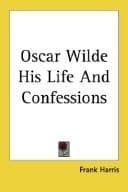
Oscar Wilde, His Life and Confessions — Volume 1Harris, Frank
History
Oscar Wilde, His Life and Confessions — Volume 1
Harris, Frank
Authors, Irish -- 19th century -- Biography; Wilde, Oscar, 1854-1900
As soon as the dreadful load of poverty was removed, Oscar began to go about a
great deal, and his wife would certainly have been invited with him if he had
refused invitations addressed to himself alone; but from the beginning he
accepted them and consequently after the first few months of marriage his wife
went out but little, and later children came and kept her at home. Having
earned a respite from care by his marriage, Oscar did little for the next three
years but talk. Critical observers began to make up their minds that he was a
talker and not a writer. "He was a power in the art," as de Quincey said of
Coleridge; "and he carried a new art into the power." Every year this gift grew
with him: every year he talked more and more brilliantly, and he was allowed
now, and indeed expected, to hold the table.
In London there is no such thing as conversation. Now and then one hears a
caustic or witty phrase, but nothing more. The tone of good society everywhere
is to be pleasant without being prominent. In every other European country,
however, able men are encouraged to talk; in England alone they are discouraged.
People in society use a debased jargon or slang, snobbish shibboleths for the
most part, and the majority resent any one man monopolising attention. But
Oscar Wilde was allowed this privileged position, was encouraged to hold forth
to amuse people, as singers are brought in to sing after dinner.
Though his fame as a witty and delightful talker grew from week to week, even
his marriage did not stifle the undertone of dislike and disgust. Now
indignantly, now with contempt, men spoke of him as abandoned, a creature of
unnatural viciousness. There were certain houses in the best set of London
society the doors of which were closed to him.
CHAPTER VI--OSCAR WILDE'S FAITH AND PRACTICE
From 1884 on I met Oscar Wilde continually, now at the theatre, now in some
society drawing room; most often, I think, at Mrs. Jeune's (afterwards Lady St.
Helier). His appearance was not in his favour; there was something oily and fat
about him that repelled me. Naturally being British-born and young I tried to
give my repugnance a moral foundation; fleshly indulgence and laziness, I said
to myself, were written all over him. The snatches of his monologues which I
caught from time to time seemed to me to consist chiefly of epigrams almost
mechanically constructed of proverbs and familiar sayings turned upside down.
Two of Balzac's characters, it will be remembered, practised this form of
humour. The desire to astonish and dazzle, the love of the uncommon for its own
sake, was so evident that I shrugged my shoulders and avoided him. One evening,
however, at Mrs. Jeune's, I got to know him better. At the very door Mrs. Jeune
came up to me:
"Have you ever met Mr. Oscar Wilde? You ought to know him: he is so
delightfully clever, so brilliant!"
Public-domain text, read in full here on John Shaqi.
Reviews
Reviews
No reviews yet
Be the first to share your thoughts on this work.
Join the Discussion
Join the discussion
Sign in to leave a comment or review.
Sign InorCreate an account