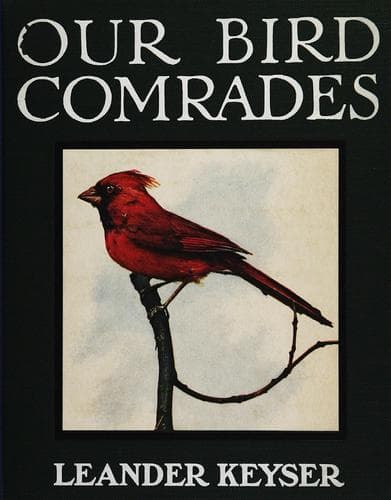
Our Bird ComradesKeyser, Leander S. (Leander Sylvester)
History
Our Bird Comrades
Keyser, Leander S. (Leander Sylvester)
Birds
Without the feathers the wing would be useless as an instrument of
flight. The shorter plumes that shield the bases of the long quill
feathers are called the coverts, which are found on both the upper and
under surfaces of the wing. They are divided into several sets,
according to the position they occupy, and are called the "primary
coverts" (because they overlie the bases of the primaries), the
"greater coverts," the "middle coverts," and the "lesser coverts."
Forming a vast expansion of the bony and fleshy framework are the
quills, or flight-feathers, called collectively the "remiges." These
plumes mainly determine the contour of the wing, and constitute a thin,
elastic surface for striking the air--one that is sufficiently
resilient to give the proper rebound and yet firm enough to support the
bird's weight. The longest quills are those that grow on the hand or
outer extremity of the wing and are known as the primaries. What are
called the secondaries are attached to the ulna of the forearm, while
the tertiaries occupy the humerus and are next to the body. All these
feathers are so placed relatively that the stiff outer vane of each
quill overlaps the more flexible inner vane of its successor, like the
leaves of certain kinds of fans, thus presenting an unbroken surface to
the air. As to the structure of these plumes, they combine firmness,
lightness, and mobility, the barbs and barbules knitting the more
flexible parts together, so that they do not separate, but only expand,
when the wing is unfolded.
[Illustration: Barn Swallow]
While the primary purpose of wings is flight, there is quite a number
of notable exceptions. A concrete example is the ostrich, whose wings
are too feeble to lift it from the ground, but evidently aid the great
fowl in running, as it holds them outspread while it skims over the
plain, perhaps using them mainly as outriggers or balancing poles in
its swift passage on its stilt-like legs. The penguins convert their
wings into fins while swimming through the water, the feathers closely
resembling scales.
Public-domain text, read in full here on John Shaqi.
Reviews
Reviews
No reviews yet
Be the first to share your thoughts on this work.
Elsewhere in the archive
Join the Discussion
Join the discussion
Sign in to leave a comment or review.
Sign InorCreate an account