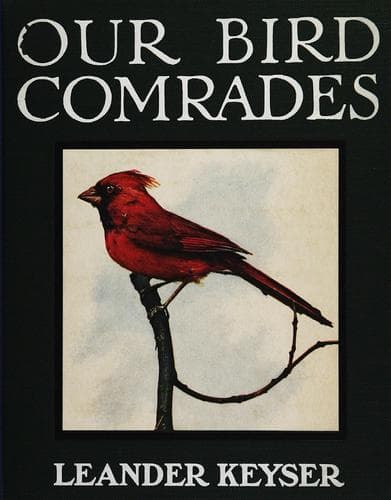
Our Bird ComradesKeyser, Leander S. (Leander Sylvester)
History
Our Bird Comrades
Keyser, Leander S. (Leander Sylvester)
Birds
There are birds of many kinds, and therefore a great variety of wings
and modes of flight. Birds with short, broad, rounded wings, with the
under surface slightly concave and the upper surface correspondingly
convex, usually have comparatively heavy bodies, and race through the
air with rapid wing-beats and rather labored flight, and compass only
short distances. Among the birds of this kind of aerial movement may
be mentioned the American meadowlark, the bob-white, and the pheasant.
Other species propel themselves in rapid, gliding, and continued flight
by means of long, narrow, and pointed wings, like the swifts, swallows,
and goatsuckers, while many others, notably herons, hawks, vultures,
and eagles, are distinguished by a vast alar expansion in proportion to
their weight, and hence are able to sustain themselves in the air by
sailing, with only a slight stroke at rare intervals. Such birds as
the stormy petrel and the frigate-bird have wings that are broad,
convex, and of great length in contrast with the lightness and small
bulk of their bodies, for which reason they are able to sustain
themselves in the air for days without rest. It is even thought that
some of these wonderful birds of the limitless ocean sleep on the wing,
though how such an hypothesis could be proved it would be difficult to
say.
Even in this day of scientific research and astuteness, it must not be
supposed that everything about the mechanics of avicular flight is
understood. We may readily comprehend how a bird, without fluttering
its wings, can poise in the air; but how can it move forward or in a
circle, and even mount upward, without a visible movement of a pinion?
And this some birds are able to do without reference to the direction
of the ethereal currents. That, I venture to say, is still a mystery.
It almost seems as if some of the masters of aerial navigation in the
bird world were gifted with the ability to propel themselves forward by
a mere act of volition.
An interesting article on the subject of bird flight appeared not long
ago in one of the foremost periodicals of the country, a part of which
is here quoted to show what a puzzling problem we have before us:
Recent developments in aerial navigation have renewed interest in the
comparative study of the mechanical principles involved in the flying
of birds. There is one exceedingly puzzling law in regard to birds and
all flying creatures, the solution of which may work far-reaching
influences in the construction of flying craft.
Public-domain text, read in full here on John Shaqi.
Reviews
Reviews
No reviews yet
Be the first to share your thoughts on this work.
Elsewhere in the archive
Join the Discussion
Join the discussion
Sign in to leave a comment or review.
Sign InorCreate an account