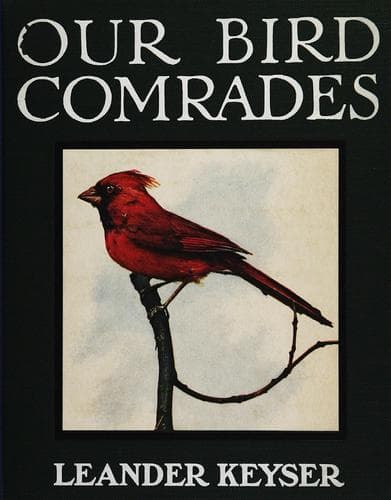
Our Bird ComradesKeyser, Leander S. (Leander Sylvester)
History
Our Bird Comrades
Keyser, Leander S. (Leander Sylvester)
Birds
"This law, which has thus far perplexed scientists, is that the heavier
and bigger the bird or insect, the less relative wing area is required
for its support. Thus the area of wing surface of a gnat is forty-nine
units of area to every one of weight. In graphic contrast to that, a
condor (_Sarcorhamphus gryphus_) which weighed 16.52 pounds had a wing
surface of 9.80 square feet. In other words, though the gnat needs
wing surface in a ratio of forty-nine square feet per pound of weight,
a great condor manages to sail along majestically with .59 of a square
foot to at least a pound of weight. The unexplained phenomenon
persists consistently throughout the whole domain of entomology and
ornithology. Going up the scale from the gnat, it is found that with
the dragon fly this ratio is 30 to 1, with the _tipula_, or
daddy-longlegs, 14.5 to 1, the cockchafer only 5.15 to 1, the
rhinoceros beetle 3.14 to 1.
"Among birds the paradoxical law that the smaller the creature the
bigger the relative supporting wings holds good. A screech owl (_Scops
zorca_) weighing one-third of a pound had 2.35 square feet of wing
surface per pound of weight. A fish hawk (_Pandion haliaetus_)
weighing nearly three pounds had a wing area of 1.08 square feet to
each pound. A turkey buzzard weighing 5.6 pounds had a little less
than one square foot of wing surface to each pound. A griffon vulture
(_Gyps fulvus_) weighing 16.52 pounds had a wing surface of only .68
square feet to the pound.
"Students of aerial navigation who are devoting much attention to
observations of birds say that if the peculiar law governing extant
flying creatures could be fathomed the problem of human flight might be
solved."
A BIRD'S FOOT
You will agree with me, after you have studied a bird's foot, that it
is one of Nature's most wonderful contrivances, so admirably adapted
for the purposes to which it is devoted that one cannot help feeling
that a Divine Mind must have planned it, just as a man would make a
watch for the express purpose of keeping time.
But what is properly included in a bird's foot? Here we shall have to
correct a popular mistake, if we wish to be accurate, in the scientific
sense of the term. Most people think that the avian foot consists only
of the toes and claws, or the part that comes in direct contact with
the ground or the perch. That, however, is an error, for the foot
really comprises, in addition to the toes and claws, the first long
bone of the limb, reaching from the base of the digits to the first
joint. You will see, therefore, that the bird walks on its toes, not
on its foot as a whole.
Public-domain text, read in full here on John Shaqi.
Reviews
Reviews
No reviews yet
Be the first to share your thoughts on this work.
Elsewhere in the archive
Join the Discussion
Join the discussion
Sign in to leave a comment or review.
Sign InorCreate an account