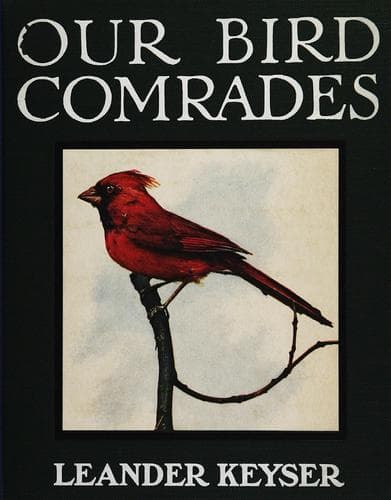
Our Bird ComradesKeyser, Leander S. (Leander Sylvester)
History
Our Bird Comrades
Keyser, Leander S. (Leander Sylvester)
Birds
The world over, there are twenty distinct species of nuthatches known
to scientific observers, but only four of them are natives of America.
Of course, there are a number of subspecies or varieties. All of them
are incessant climbers and foragers, peering into crannies, pounding
here and there to make the grubs stir in their hiding places, jabbing
and prying with their beaks, and chiseling out all kinds of larvae,
grubs, and borers that would, if permitted to live and multiply, soon
devastate the timber and fruit trees and make this world a desert
indeed. True, the other feathered clamberers and carpenters are fully
as useful, but depend upon it, the nuthatches do their share in
preserving our forests and orchards.
The white-breasted nuthatch is our most common species east of the
great plains, breeding from the Gulf States to the northern border of
the United States and to New Brunswick. One peculiarity about him is
that he breeds throughout his range, and therefore may be found as both
a summer and winter resident in all suitable localities within these
boundaries. In the winter, no matter how old Boreas may bluster, he is
one of the most cheerful denizens of the woods in our central
latitudes, calling his nasal "yank, yank, yank," and sometimes
indulging in a loud, half-merry outburst that goes echoing through the
woodlands. No sound of the sylvan solitudes has a more woodsy flavor
or is more suggestive of vernal cheer and good will. Sometimes he
chatters to his human visitors in the most cordial tones as he glides
up and down his arboreal promenade, or holds himself almost straight
out.
A hole in a stump or tree makes Madame Nuthatch a cosy nursery, which
she lines with feathers and leaves, making it soft and snug for her
downy brood. Here they are safe from most of the prowlers that find
the more exposed nests of many other birds. She deposits five to eight
eggs of a white or creamy-white ground-color, speckled with rufous and
lavender. During the season of incubation and brood rearing the
nuthatches retire to the depth of the woods, and are quiet, secretive,
and unsocial, seldom betraying their procreant secrets.
These birds have another habit that is worth mentioning. Having found
a larger supply of food than they require for their immediate use, they
carry morsels away and jam them into all sorts of holes and crannies in
the bark of the trees. I have watched a pair for an hour diligently
laying by a store of sunflower seeds, which they had found at the edge
of the woods. They do not store a quantity of provision in one place
like the squirrels, but deposit a tidbit here and there, wedging it
tightly into a crevice by hammering it with their stout bills. Of
course, the woodpeckers and tomtits secure many of these half-hidden
goodies, but Master Nuthatch does not mind that, for he evens up the
theft by appropriating their stores when he finds them.
Public-domain text, read in full here on John Shaqi.
Reviews
Reviews
No reviews yet
Be the first to share your thoughts on this work.
Join the Discussion
Join the discussion
Sign in to leave a comment or review.
Sign InorCreate an account