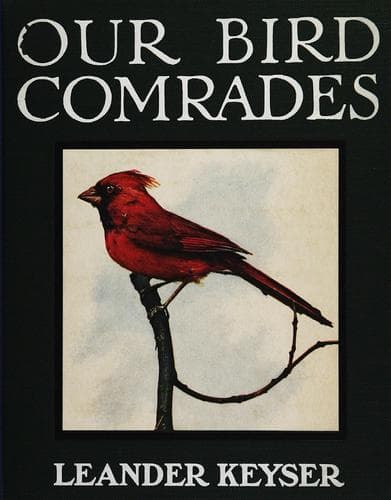
Our Bird ComradesKeyser, Leander S. (Leander Sylvester)
History
Our Bird Comrades
Keyser, Leander S. (Leander Sylvester)
Birds
But what is to be said of the screaming cowbird? Instead of inflicting
its eggs on its more distant avian relatives, it watches its chance and
slyly drops them into the domicile of its bay-winged cousins, and
actually makes them hatch and rear its offspring! This seems to be
carrying imposture to the extreme of refinement, or possibly developing
it into a fine art, and reminds one of those human good-for-naughts who
"sponge" off their relatives rather than go among strangers.
Before closing this chapter I must call attention to one of the most
surprising discoveries ever made by an American observer of bird ways.
It was reported some time after my article on the cowbird was first
published in Appleton's "Popular Science Monthly." The observer was
Joseph F. Honecker, whose statement was printed in "American
Ornithology" for June, 1902, and runs as follows:
"As ornithologists and all bird students think and believe that the
cowbird will build no nest, but always lays in the nests of other
birds, I am glad to give the results of my experiments. In order to
get the desired results, in the spring of 1899 I secured a pair of
cowbirds and placed them in a large cage, cared well for them, and
supplied them with plenty of nesting material. To my surprise, the
female built a nest, laid four eggs, hatched them, and reared the
young, and on July twenty-eighth, young and old were given their
freedom. This will show that the cowbird will build a nest and care
for its young in captivity, while in its wild life it has never been
known to do so."
A BLUE CANNIBAL*
*Reprinted by permission from "The Evening Post," New York.
In his coat of light blue, trimmed with white and black, bearing his
crest jauntily atop of his head, the blue jay presents an attractive
picture. And, indeed, although I myself feel that the Baltimore
oriole, the scarlet tanager, the ruby-throated hummingbird, and many of
the wood warblers carry off the palm for brilliancy of plumage, there
are persons who declare that the jay is the most handsomely colored
bird in our temperate regions.
Public-domain text, read in full here on John Shaqi.
Reviews
Reviews
No reviews yet
Be the first to share your thoughts on this work.
Join the Discussion
Join the discussion
Sign in to leave a comment or review.
Sign InorCreate an account