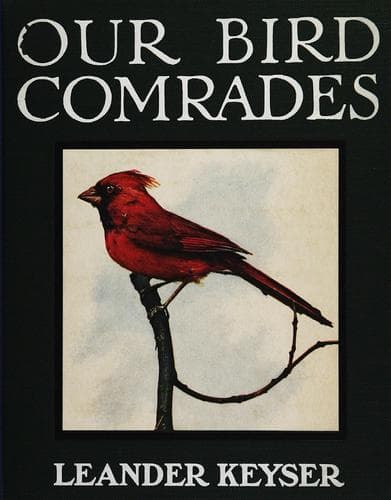
Our Bird ComradesKeyser, Leander S. (Leander Sylvester)
History
Our Bird Comrades
Keyser, Leander S. (Leander Sylvester)
Birds
His demands upon domesticated fruits and grains are comparatively
light. He cares more for acorns and mast than for corn. The last he
does not greatly relish, but eats it chiefly when the snow covers his
favorite food. It is a little surprising that he occasionally varies
his diet with fish, salamanders, tree frogs, mice, and shrews. Mr.
Beal's conclusion is put in the following sentence, which closes his
valuable monograph: "In fact, the examination of nearly three hundred
stomachs shows that the blue jay does far more good than harm."
An important question, therefore, from more than one point of view is:
Should we ever kill the blue jay? Perhaps as sensible an answer to
that question as can be given is this: We should by no means engage in
a war of extermination upon the jays, but it might be wise, when they
become too abundant, to thin out their numbers somewhat by shooting
some of them or driving them away. It can scarcely be denied that if
they are permitted to thrive without hindrance, and grow to large
numbers, they will become sorely destructive of the eggs and nestlings
of more desirable birds. I assure you, however, that I make this
statement with reluctance and reserve, for the handsome blue-coat is
one of our most cunning and interesting birds, and would be greatly
missed if he were exterminated.
The blue jay is also a plucky bird, as I discovered one day not so very
long ago. A pair of jays had a nest in a little park in front of my
house, and one day one of the youngsters, which were still unable to
fly, dropped to the ground. Fearing the cats or evilly disposed boys
might catch the little fellow, I thought to do him and his parents a
good turn by catching him and putting him up in one of the trees beyond
the reach of his enemies. After quite a chase I succeeded in catching
him. But the parent birds, flitting and calling in the trees, did not
understand my well-meant intentions, and so one of them swung down and
struck me on the top of the head with so much force that, either with
his bill or his claws; he punctured the skin and made the blood come,
leaving a scar on my crown for quite a while. The pesky thing! I
think he might have known that I was his friend--but he didn't, his
instinct not being a sure guide that time. But who can blame him? Not
an hour afterwards the youngling again fell to the ground, when some
children found it and killed it without the least excuse for their
action. In such a case how could the parent birds distinguish between
friend and foe? They found their little one lying dead on the ground,
and mourned for it with heart-broken cries.
Public-domain text, read in full here on John Shaqi.
Reviews
Reviews
No reviews yet
Be the first to share your thoughts on this work.
Join the Discussion
Join the discussion
Sign in to leave a comment or review.
Sign InorCreate an account