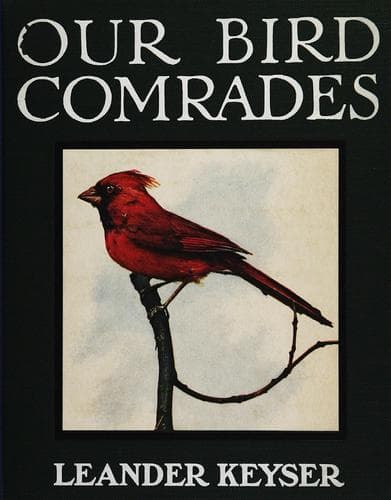
Our Bird ComradesKeyser, Leander S. (Leander Sylvester)
History
Our Bird Comrades
Keyser, Leander S. (Leander Sylvester)
Birds
Going back to Kansas in winter, we note that the song sparrows, instead
of remaining at one place, shifted about a good deal more than I had
ever known them to do in the East. In December a pair found a dwelling
in the weed clumps and brush heaps of a hollow a short distance from
the Missouri River; but they soon deserted this spot, well sheltered as
it was, none being seen there until the twenty-third of February. It
surprised me to find another pair, and sometimes two pairs, in a
thicket right on the bank of the wide river, where they were exposed to
many of the winter blasts, especially those that swept down from the
frozen north. Up in the deep, winding ravine they might have had
excellent shelter and, so far as I could see, just as good feeding.
However, I have long ago learned that there is no accounting for tastes
in the bird realm any more than in the human realm.
The hardiest of the _Mniotiltidae_ tribe are the myrtle warblers, which
dapple the whitened edges of winter, both autumn and spring, with their
golden rumps and amber brooches. Evidently these birds are shyer of
the rigorous Ohio winters than of the more mild-mannered Kansas
weather. In the former state I never saw a myrtle warbler after the
first or second week in November, while in Kansas I came upon a flock
of them in a wooded hollow by the river on the eighth of December,
1897, and then after a severe snowstorm had swept over the region from
the western prairies. It seemed odd to find these dainty featherland
blossoms when the whole country was covered with an ermine of snow.
Then they disappeared, and I did not expect to see them again until the
next spring; but on the fourteenth of February, which was a warm,
vernal day thrust into the midst of winter, a flock of perhaps a dozen
were flitting and chirping among the trees in the suburbs of the city,
their hoarse little _chep_, always giving one the impression that the
birds have taken a cold which has affected their vocal cords, sounding
as familiar as of old. However, that very evening at dusk a black
cloud, charged with electricity and bellowing with anger, came up out
of the west like a young Lochinvar, and hurled a fierce storm across
the hills and valleys, and the next day not a myrtle warbler was to be
seen in all the countryside, though I tramped weary miles in search of
them. The tempest had doubtless frightened them away to the suaver
southland, from which they did not return until the following spring.
Public-domain text, read in full here on John Shaqi.
Reviews
Reviews
No reviews yet
Be the first to share your thoughts on this work.
Elsewhere in the archive
Join the Discussion
Join the discussion
Sign in to leave a comment or review.
Sign InorCreate an account