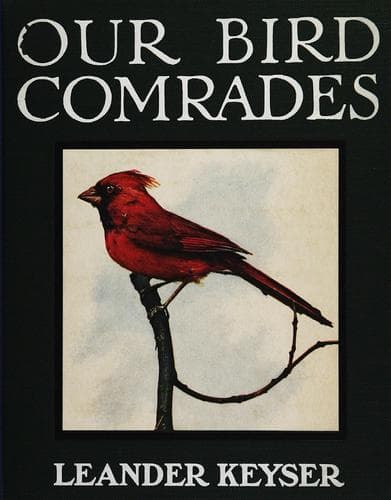
Our Bird ComradesKeyser, Leander S. (Leander Sylvester)
History
Our Bird Comrades
Keyser, Leander S. (Leander Sylvester)
Birds
It is not often you catch a bird in the singing mood in the winter; yet
on December 19, a purple finch was piping quite a vivacious tune in the
woods. Of course, he was not in his best voice, but his performance
was good enough to entitle it to the name of bird music. The finches,
by the way, are strong flyers. At your approach, instead of flitting
off a little way, perhaps to the next tree or bush, after the manner of
the tits and nuthatches and many other birds, the finches tarry in the
tree-tops as long as they deem it safe, then take to wing and fly to a
distant part of the woods, and you may not see them again that day.
However, they may come back to you after a while, as if they relished
your company. The goldfinches are also long-distance flyers, not
flitters. Usually they give some signal of their presence, either by
their vivacious "pe-chick-o-pe" or their childlike and semi-musical
calls; but there are times when a good-sized flock of them will
suddenly appear in the tree-tops above you, and you cannot tell when
they arrived, for you did not see them there at all a few minutes
before.
WAYSIDE OBSERVATIONS
The previous chapter closed with some notes on the behavior of birds in
the winter time. My home rambling grounds in northeastern Kansas were
extremely undulating, cut up into ridges and ravines, most of which
were covered with a thick growth of weeds, bushes, and timber. In some
places the thickets were so dense as to be almost impenetrable. This
diversity in the topography of the country afforded considerable
variety in the faunal life of the region.
For example, in bitter winter weather most of the birds would hug the
sheltered hollows, where they found coverts in the copses, and would
avoid the hilltops, which were exposed to the nipping winds blowing
from the western prairies. As the spring approached, bringing blander
weather, they gradually moved up the hillsides, many of them finding
billsome seeds and berries on the summits.
However, note a difference in the temperament of individuals of the
same species. On the bitterest days of winter I would sometimes leave
the sheltered hollows and lowlands and clamber to the summits of the
wind-swept hills, and, oddly enough, on the exposed heights I
occasionally flushed a solitary bird, which would spring up from the
weeds or copses and dart away with a frightened cry. More than likely
it would be an individual of the same species as some of the more
socially disposed tenants of the lower grounds, but for some reason,
what, I know not, it preferred the life of an anchorite; it did not
care for society, even of its own kith. Invariably, too, these
feathered recluses were extremely shy, scuttling away like frightened
deer as I approached their cloistered haunts.
Public-domain text, read in full here on John Shaqi.
Reviews
Reviews
No reviews yet
Be the first to share your thoughts on this work.
Elsewhere in the archive
Join the Discussion
Join the discussion
Sign in to leave a comment or review.
Sign InorCreate an account