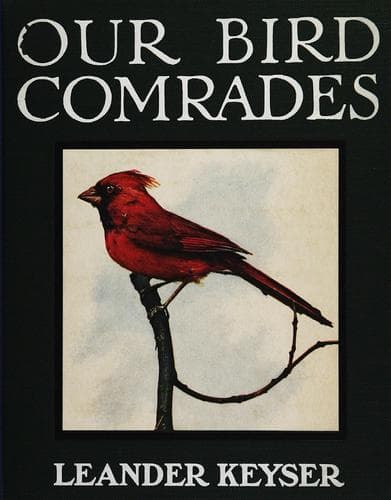
Our Bird ComradesKeyser, Leander S. (Leander Sylvester)
History
Our Bird Comrades
Keyser, Leander S. (Leander Sylvester)
Birds
These notes stir several queries in one's mind. Is there such a thing
as social ostracism in the bird world? Might these hilltop eremites
have committed some crime or some breach of decorum that effected their
banishment from respectable avicular society? Or were they simply of a
sullen or retiring disposition, choosing seclusion rather than the
company of their kind? These questions must be left unanswered. Most
frequently the lone bird would be a song sparrow. Once a brilliant
cardinal was trying to conceal himself in a clump of bushes and weeds
far up the hillside, acting very much like a social outcast. For some
reason that he did not see fit to explain he wanted to be alone.
If the song sparrows of eastern Kansas belie their name and seldom fall
into the lyrical mood, as has been said, the like cannot be said of the
robins, which, in the proper season, were very lavish of their
minstrelsy. Their favorite singing time in the West, as in the East,
was at the "peep of dawn." How often their ringing carols broke into
my early morning dreams!
Have you ever noticed the tentative efforts of the robins in the early
spring, at the beginning of the song season, before they get their
harps in full tune? It is interesting and amusing to listen to their
rehearsals, of which they need quite a number before they acquire full
control of their voices. This is the method: Starting off on a tune,
they will keep it up until their voices break; then they will stop a
while to recover breath, and presently make another attempt with
perhaps slightly better success. At first they are able to pipe only a
syllable or two before their voices break. After a while they succeed
in carrying the tune for a respectable little run, but sooner or later
their voices will go all to pieces or slide up into a falsetto, making
another pause necessary. By and by, however, after much practice, they
gain perfect vocal control, and are able to sustain their songs for a
long time without a mishap. When the voice of the rehearsing bird
breaks, it apparently runs too high in the scale for the bird's
register, just as the voice of a sixteen-year-old boy is apt to do, to
his own confusion and the amusement of his friends.
[Illustration: Cardinal]
Public-domain text, read in full here on John Shaqi.
Reviews
Reviews
No reviews yet
Be the first to share your thoughts on this work.
Elsewhere in the archive
Join the Discussion
Join the discussion
Sign in to leave a comment or review.
Sign InorCreate an account