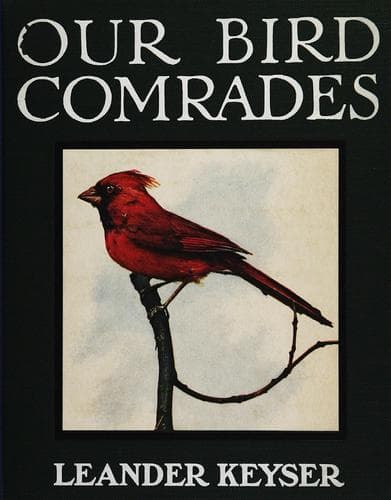
Our Bird ComradesKeyser, Leander S. (Leander Sylvester)
History
Our Bird Comrades
Keyser, Leander S. (Leander Sylvester)
Birds
One spring I made up my mind to make a closer study than ever of the
dainty creeping warbler, wishing to know just how he contrives to
scuttle up and down the boles and branches of the trees with so much
ease and grace. He is the only warbler we have in eastern North
America that makes a habit of scaling the tree trunks and descending
them head downward. How does he do this? The muscles of his legs and
pelvis are as elastic as India rubber, so that he can twist and twirl
about in a marvelous way, pointing his head one moment to the east and
the next, without losing his hold, in the opposite direction. He is
able to swing himself around almost as if he were hung on a pivot.
But how does he hold himself on his shaggy wall as he hitches head
downward? Just as the nuthatch does--not by keeping both feet directly
under him, as most people suppose, but by thrusting one foot slightly
forward and the other outward and backward, thus preserving his balance
at the same time that he holds himself firmly with his sharp little
claws to his upright wall. Some of the pictures of the creeper seen in
the books are not quite true to creeper methods of clinging and
locomotion, for they represent him as stuck to the bark of a tree trunk
with both feet invisible, presumably held directly under his striped
breast. In the real position it is likely that one or both feet could
be seen, the one thrust forward and the other flung back and to one
side. At least one foot would be visible, whatever the angle at which
the bird would be inspected, and from many points of view both of his
tiny feet may be plainly seen in the position described.
Our little striped friend, usually called in the books the
black-and-white warbler, is not, after all, so expert a creeper as is
the nuthatch, which may be called the arboreal skater _par excellence_.
The warbler does not go scuttling straight down a vertical bole or
branch as the nuthatch does, but swings his lithe body from side to
side, as if he did not loosen the hold of both feet simultaneously but
alternately. Besides, both in ascending and descending he must have
more frequent recourse to his wings to tide him over the difficult
places. While the nuthatch can glide over the smoothest and hardest
bark, and even descend the wall of a brick house, his sharp claws
taking a firm grip on the edges of the bricks, the warbler is not quite
so much of a gymnast, for when he strikes a difficult spot in his
promenade ground, he flies or flits over it to the next protuberance
which his claws can hold. He has a decided advantage, however, over
all his warbler kin, for he is not only gifted with the creeping
talent, but is also just as dexterous as they in perching on a
horizontal twig.
Public-domain text, read in full here on John Shaqi.
Reviews
Reviews
No reviews yet
Be the first to share your thoughts on this work.
Elsewhere in the archive
Join the Discussion
Join the discussion
Sign in to leave a comment or review.
Sign InorCreate an account