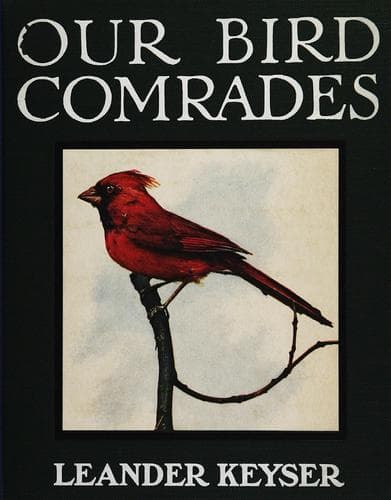
Our Bird ComradesKeyser, Leander S. (Leander Sylvester)
History
Our Bird Comrades
Keyser, Leander S. (Leander Sylvester)
Birds
The little bird known as the brown creeper belongs to a different
avicular family entirely, but in one respect he is like the
black-and-white warbler--that is, he scales the trunks and branches of
the trees. There, however, the resemblance ceases, for the creeper
rarely goes head downward, evidently thinking that the proper position
for a bird's head is pointing toward the sky, not toward the ground.
Besides, he seldom, if ever, sits crosswise on a perch; no, he is an
inveterate creeper. My study of him proves that he does not hold his
feet directly under his breast, but spreads them out well toward either
side, knowing instinctively how to make a broad enough base to enable
him to preserve his center of gravity.
Like the woodpecker, he uses his stiff tail as a brace; nor does he go
zigzagging up his wall after the manner of the creeping warbler, but
hitches along in a direct line--unless, of course, a tidbit attracts
him to one side--proving that he is a true creeper, one to the manner
born. However, the warbler has one advantage--he is able to perch with
perfect security on a twig, an accomplishment that has not yet been
attained by his little brown cousin. How cunningly the creeper peeps
into the crannies of the bark as he plies his trade, thrusts his long,
curved beak into the tiny holes and crevices, and draws out a worm or a
grub, which the next moment goes twinkling down his throat! His
economic value to the farmer and the fruit grower cannot be estimated,
and he should never be destroyed.
The conduct of different birds is not alike upon their arrival from the
South at their summer nesting haunts in our more northern latitudes;
some heralding their advent with jubilant song as if in greeting to the
familiar scenes, while others are silent and wary. The first I knew of
the Baltimore and orchard orioles last spring, they were singing
blithely in the trees about the house; but the brown thrashers flitted
about slyly and silently for a few days, apparently to make sure that
the coast was clear of danger; having done which, they burst into their
dithyrambs with a will. Out in the woodland the gorgeous scarlet
tanager announced his arrival one morning with a lively sonnet, which
was heard long before the singer was seen; whereas his cousin, the
summer tanager, uttered only his quaint alarm-call, "Chip-burn,
chip-burn," and was excessively shy, dashing wildly away as I
approached, unwilling to vouchsafe a wisp of song. Once he even
pounced angrily upon his black-winged relative and drove him to the
other side of the hollow, precisely as if he meant to say, "Your
singing is out of place, sir, and dangerous, too! Don't you know that
the man prowling about yonder will shoot little birds who betray their
presence by singing?"
[Illustration: Baltimore Oriole]
Public-domain text, read in full here on John Shaqi.
Reviews
Reviews
No reviews yet
Be the first to share your thoughts on this work.
Elsewhere in the archive
Join the Discussion
Join the discussion
Sign in to leave a comment or review.
Sign InorCreate an account