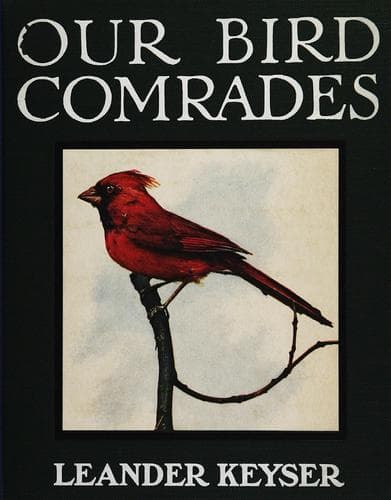
Our Bird ComradesKeyser, Leander S. (Leander Sylvester)
History
Our Bird Comrades
Keyser, Leander S. (Leander Sylvester)
Birds
Were there ever such pesky, ill-mannered citizens as the English
sparrows? Here comes a downy woodpecker, or a cardinal, or a
rose-breasted grosbeak to town, flitting about the trees of my yard,
gathering goodies among the leaves and twigs, and perhaps piping a
little aria at intervals, congratulating himself on having found a
pleasant, quiet place, when, lo! a gang of English sparrows crowd
around him, peering at him now with one eye, now with the other,
canting their heads in their impertinent way, bowing and scraping and
blinking, and for all the world seeming to make such derisive remarks
as, "Oh, what a fine fellow! Quite stuck-up, ain't he? Isn't that a
stylish topknot, though? He! he! he! Look! he wears a rose on his
shirt bosom! Isn't he a dandy? Ge! ge! gah! gah!" By and by the
visitor can stand the racket and the mockery no longer; and so he
steals away, resolved never again to go to that place to be insulted.
I have repeatedly been witness of just such occurrences.
Early in the spring a robin began to build her nest in the middle story
of one of my maple trees. The whole process was narrowly watched by
the noisy, hectoring sparrows. They gathered about her, prying and
bobbing and jostling and chirping, staring at her like a lot of
bumpkins when she leaped into the half-finished cup and molded her
building material with her ruddy bosom. They seemed to be saying
jeeringly: "Isn't that a funny way for a bird to build a house? Hay!
hay! hay!" The robin forsook her nest; and the sparrows borrowed her
timbers for their own nest, and forgot to bring them back again.
Just a moment ago a couple of young red-headed woodpeckers and their
parents visited the trees of my yard, making a lively din, for the
youngsters were calling for their supper. Then the sparrows crowded
about them, called and jested, followed them from tree to tree, never
stopping their persecutions until the red-headed family flew off in
disgust.
In a Kansas town one March day, as I was returning to the house in
which I was lodging, my attention was attracted to a black-capped
chickadee, which was flitting about and calling in an agitated way in
one of the trees. Two English sparrows, a cock and his mate, were
responsible for the little bird's perturbation. What were they doing?
Something rude, as usual. Perched on a couple of twigs, they were
bending over, stretching out their necks and peering into a small hole
in one of the larger branches. The male was especially offensive,
standing there and staring into the cavity, and making insolent remarks.
A good-sized club, hurled by myself, sent the sparrows to other parts.
Then I hurried into the house and sat by the curtained window to watch.
With much ado, the little black-cap flew over to the limb with the
cavity. He flitted about a few moments, then darted to the opening and
looked in, chirping in a reassuring tone, as much as to say, "The
ruffians are gone now; you can come out."
Public-domain text, read in full here on John Shaqi.
Reviews
Reviews
No reviews yet
Be the first to share your thoughts on this work.
Elsewhere in the archive
Join the Discussion
Join the discussion
Sign in to leave a comment or review.
Sign InorCreate an account