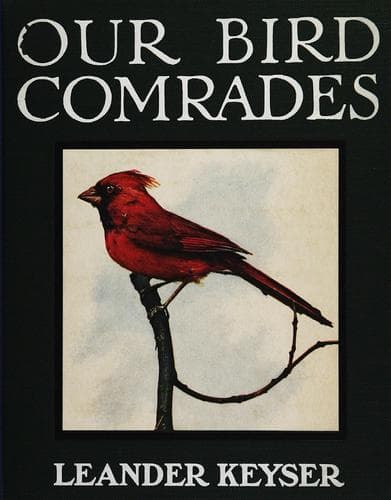
Our Bird ComradesKeyser, Leander S. (Leander Sylvester)
History
Our Bird Comrades
Keyser, Leander S. (Leander Sylvester)
Birds
One of our most lavish singers all summer long is the indigo bunting;
yet when he first came back from the South he was very shy, and his
voice seemed to be out of tune, so that, even when he tried to sing,
which was seldom, his effort sounded like the creaking of a rusty
door-hinge. Afterwards, however, when he got the cobwebs out of his
larynx, he made up for all his previous silence. Quite different is
the habit of the towhee, which announces his presence by his loud,
explosive trill--all too brief--or his complaining "chewing."
Sometimes the rambler and bird gazer meets with other than avian
"specimens" in his excursions. One evening I was loitering in a
distant hollow, ogling with my field glass several lark sparrows that
were flitting about on the ground in an adjacent patch of some kind.
The birds were singing as only these beautiful sparrows can, and the
quiet of the evening lent an idyllic charm to their rich and varied
chansons. On the other side of a small stream stood a shanty, in the
door of which sat an old negro woman. In looking at the birds, I
sometimes turned the glass toward the shanty, although too intent on my
studies to notice it. Presently the woman could no longer endure my
apparent espionage, and so she said: "Go 'bout yer own business,
mister, 'n' don' ye be spyin' inter my house!"
TROUBLE AMONG THE BIRDS*
*The larger part of this chapter was first published in "The Christian
Endeavor World," Boston; the rest of it in "Our Animal Friends," New
York. I reprint it here by permission of both these journals.
Even at the risk of causing a feeling of dejection on the reader's
part, I am going to put one "trouble" chapter into this volume. There
are trials in the birds' domain, and perhaps you and I will feel more
sympathy with them, and will be led to protect them all the more
carefully, if we know something about the "deep waters of affliction"
through which they are sometimes compelled to pass. Our native
American birds, at least some of them, suffer a good deal at the hands,
so to speak, of the pestiferous English sparrows, which were introduced
into this country by some egregious blunder.
There can be no doubt that the English sparrows are regular bullies.
They do not fight other birds so much as they hector them, making life
intolerable by their ribaldry, coarse jests, and prying manners. Some
birds, especially many of our beautiful native species, are sensitively
organized, and cannot endure such boorish society as the badly bred
foreigners furnish. That as much as anything has driven our genteel
bluebirds away from our homes into the woods and other out-of-the-way
places. How would you feel, my friend, if, as you were going along the
street, a lot of hoodlums should take to gibing and hooting at you?
Public-domain text, read in full here on John Shaqi.
Reviews
Reviews
No reviews yet
Be the first to share your thoughts on this work.
Elsewhere in the archive
Join the Discussion
Join the discussion
Sign in to leave a comment or review.
Sign InorCreate an account