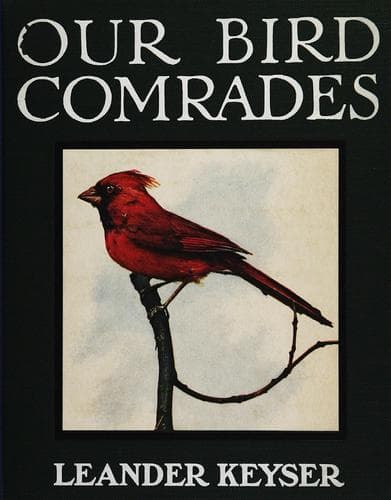
Our Bird ComradesKeyser, Leander S. (Leander Sylvester)
History
Our Bird Comrades
Keyser, Leander S. (Leander Sylvester)
Birds
*Reprinted by permission from "Forest and Stream."
So far as regards the recent discussion as to how animals learn,
whether by instinct or instruction, my study of birds leads me to take
a middle position; perhaps I would better say to take sides with both
parties. Birds acquire knowledge partly by instinct and partly by
tutelage, and the same is no doubt true of all other animals. This
statement will be borne out by several concrete cases.
Some years ago I made a number of experiments in rearing young birds
taken as early as possible from the nest. Among them were meadowlarks,
red-winged blackbirds, brown thrashers, blue jays, wood thrushes,
catbirds, flickers, red-headed woodpeckers, and several other species.
Nearly all of them were secured some time before they were naturally
ready to leave their natal places. Without any instruction from
parents or older birds they soon left the nests I had improvised for
them, hopped about on the cage floor for a while, and presently
insisted on clambering upon the perches, to which they clung in the
regulation way. Indeed, I noted again and again that the impulse to
seek a perch was so strong that the young birds seemed to be moved to
it by an imperative command. Nor were they long satisfied with a low
perch, but instinctively mounted to the highest one they could find.
The same was true in regard to flight. No feathered adult was present
to tutor them in the art of using their wings, yet they soon acquired
that power of their own accord. It was inborn--the gift of flight.
True, they were awkward at first, and gained skill only by degrees, but
the original impulse was in their constitution. It is no doubt true
that parent birds in the outdoors do give their young lessons in
flight, but if the bantlings were left to themselves, they would
acquire that art through their original endowment, although more slowly
and with many more hard knocks.
As every one knows, juvenile birds at first open their mouths for their
food. Proof may not be at hand for the opinion, but I am disposed to
believe that they never need to be told by their parents to do that;
their instincts prompt them. It must be so, I think, for to suppose
that the bird baby only a day or two from the shell could understand a
parental command to open its mouth would be to presume that it has the
instinct to grasp the meaning of such a behest, and that is more
difficult to believe than that Nature simply impels it to take its food
by opening its mandibles.
Public-domain text, read in full here on John Shaqi.
Reviews
Reviews
No reviews yet
Be the first to share your thoughts on this work.
Elsewhere in the archive
Join the Discussion
Join the discussion
Sign in to leave a comment or review.
Sign InorCreate an account