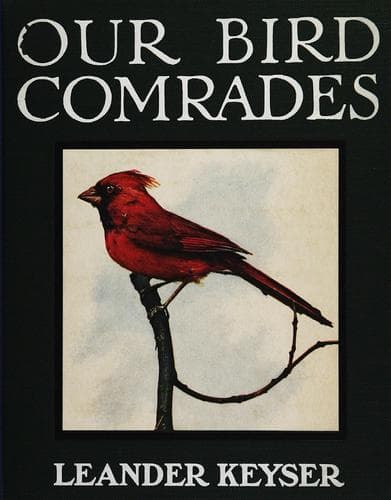
Our Bird ComradesKeyser, Leander S. (Leander Sylvester)
History
Our Bird Comrades
Keyser, Leander S. (Leander Sylvester)
Birds
Now, when the young birds are taken from the nest and reared by hand,
they insist for a long time on being fed in the juvenile manner.
However, by and by they begin of their own volition to pick up food
after the manner of the adults. At first they are very clumsy about
it, but they persevere until they acquire skill, and presently they
refuse entirely to open their mandibles for food. Here again Nature is
their sole guide. Without human or avian suggestion they also learn to
drink in the well-known bird fashion; also to bathe, chirp, frolic, and
do many other things. Who has ever seen a pet bird in drinking try to
lap like a dog, or take in long draughts like a cow or a horse? No;
Nature made them birds, and birds they will be. It is noticeable, too,
that when birds begin to peck, or bathe, or seek a perch, they do not
usually act as if they were deliberately planning to do so, nor as if
they were carrying on some process of thought leading to choice, but
rather as if they were impelled by Nature to do so.
The chirping of birds is mostly, if not wholly, a matter of
inheritance. For instance, my little wood thrushes, as soon as they
reached a sufficient age, called just like their relatives of the
sylvan solitudes; my brown thrashers uttered the labial chirp of the
species; my red-winged blackbird exclaimed "Chack! chack!" after the
manner of his kind; my bluebirds expressed their feelings in the sad
little purr of _Sialia sialis_; my flickers did not borrow the calls of
the red-heads, but each clung to its own language; my catbirds mewed
like poor pussy in trouble; and so on through the whole list. True,
these pets may have heard their parents' calls before they were taken
from the nest, but it is not at all likely that they would have
remembered them, for at first they only "cheeped" after the manner of
most bantlings, and only a good while afterward did they fall to using
the adult chirp. Besides, while still in the nest, they must have
heard many other bird calls; why did they not acquire them? Heredity
has laid a strong hand upon birds, and has drawn sharp dividing lines
among the various species.
Instinct also plays a large part in moving the bird to sing and to
render the peculiar arias of its kind. For instance, a pet wood thrush
of mine, secured at an early age and kept far away from all his kith of
the wildwood, became a fine musician. And what do you suppose was the
tune he executed? It was the sweet, dreamy, somewhat labored song of
the wood thrush in his native wilds. He never sang any other tune. I
think he sang it better than any wild thrush I have ever heard. It was
louder, clearer, more full-toned, but the quality of voice and the
technique were precisely the same. Who was his teacher? No one but
Nature, heredity, instinct, whatever you choose to call it. There was
no wild thrush within a half mile of his cage.
[Illustration: Robin]
Public-domain text, read in full here on John Shaqi.
Reviews
Reviews
No reviews yet
Be the first to share your thoughts on this work.
Elsewhere in the archive
Join the Discussion
Join the discussion
Sign in to leave a comment or review.
Sign InorCreate an account