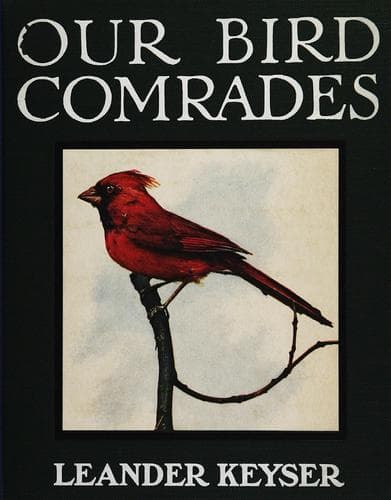
Our Bird ComradesKeyser, Leander S. (Leander Sylvester)
History
Our Bird Comrades
Keyser, Leander S. (Leander Sylvester)
Birds
The case of a pet thrasher was almost as striking. It is true, he may
have heard several of his kin singing about the premises during the
first spring of his captivity, but it is not probable that he learned
their melodies so early in life. As the next spring approached, he
began to sing the very medleys that the wild thrashers sing with so
much earnestness and skill, and this was long before any thrashers had
come back from the South.
I must now describe several cases in which inherited instinct did not
prove so true a teacher. A young robin was once given me by a friend,
and was kept by myself and others until the following summer. Strange
as it may seem, he never acquired the well-known robin carol.
Sometimes there were vague hints of it in his vocal performances, but
for the most part he whistled strains in a loud, shrill tone that no
wild robin ever dreamed of inflicting on the world. They were more
like crude human efforts at whistling than anything else. Indeed, I
think they were picked up from the whistling he heard about the house.
Some of his strains were very sweet, and all of them were wonderful for
a bird. A friend played "Yankee Doodle" on a cornet, and Master
'Rastus--for that was his name--gave a very fair and funny imitation of
part of the air. There were many robins caroling in the trees about
the premises, and 'Rastus was often left out of doors among them, but
he never acquired the red-breast minstrelsy.
A similar instance was that of a pet red-winged blackbird, which,
instead of whistling the labored "Grook-o-lee" of his species, learned
to mimic all kinds of sounds in and out of the house, among them the
crowing of the cocks of the barnyard. These two instances would
indicate that some birds must at least be associated with their kin in
order to learn the songs of their species.
My comical pet blue jay gave proof of the need of parental training.
While he intuitively called like a jay, he never was able to sing the
sweet, gurgling roulade of the wild jays. On the contrary, he treated
us to all kinds of odd, imitative, mirth-provoking performances that no
self-respecting jay in the open would think of enacting. After several
months of cage life he was given his liberty. Now, indeed, he showed
his lack of jay bringing up, and how little, in some respects, mere
instinct can be relied on. When evening came he perched on a limb of
the maple tree before the house, in a place as exposed as he could well
find, not knowing that there was more danger in an outdoor roost than
in his shielding cage. I could not induce him to come down, nor could
I climb out to the branch on which he sat, and so I was compelled to
leave him out of doors.
Public-domain text, read in full here on John Shaqi.
Reviews
Reviews
No reviews yet
Be the first to share your thoughts on this work.
Elsewhere in the archive
Join the Discussion
Join the discussion
Sign in to leave a comment or review.
Sign InorCreate an account