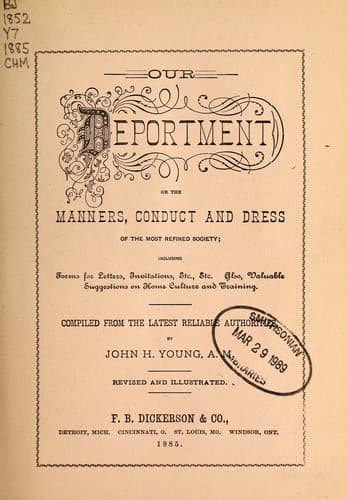
Our Deportment: Or the Manners, Conduct and Dress of the Most Refined SocietyYoung, John H.
General
Our Deportment: Or the Manners, Conduct and Dress of the Most Refined Society
Young, John H.
Etiquette
Virtue is the child of good habits, and the formation of habits may be
said to almost constitute the whole work of education. The mother can
create habits which shall mold character and enable the mind to maintain
that habitual sense of duty which gives command over the passions, and
power to fight temptation, and which makes obedience to principle
comparatively easy, under most circumstances. The social and domestic
life are marred by habits which have grown into a second nature. It is
not in an occasional act of civility that the charm of either home or
society consists, but in continued practice of courtesy and respect for
the rights and feelings of those around us. Whatever may be the precepts
for a home, the practices of the fireside will give form to the habits.
Parents who indulge in gossip, scandal, slander and tale-telling, will
rear children possessing the same tastes and deteriorating habits. A
parent's example outlines the child's character. It sinks down deep into
his heart and influences his whole life for good or for evil. A parent
should carefully avoid speaking evil of others, and should never exhibit
faults requiring the mantle of charity to cover. A parent's example
should be such as to excite an abhorrence of evil speaking, of tattling
and of uncharitable construction of the motives of others. Let the
mother begin the proper training of her children in early life and she
will be able to so mold their characters that not only will they acquire
the habit of bridling the tongue, but they will learn to avoid the
presence of the slanderer as they do a deadly viper.
POLITENESS AT HOME.
Genuine politeness is a great fosterer of domestic love, and those who
are habitually polished at home are those who exhibit good manners when
abroad. When parents receive any little attention from their children,
they should thank them for it. They should ask a favor only in a
courteous way; never reply to questions in monosyllables, or indulge in
the rudeness of paying no attention to a question, for such an example
will be surely followed by the children. Parents sometimes thoughtlessly
allow their children to form habits of disrespect in the home circle,
which crop out in the bad manners that are found in society.
HOW TO REPROVE.
Parents should never check expressions of tenderness in their children,
nor humiliate them before others. This will not only cause suffering to
little sensitive hearts, but will tend to harden them. Reproof, if
needed, should be administered to each child singly and alone.
CHEERFULNESS AT THE TABLE.
Public-domain text, read in full here on John Shaqi.
Reviews
Reviews
No reviews yet
Be the first to share your thoughts on this work.
Elsewhere in the archive
Join the Discussion
Join the discussion
Sign in to leave a comment or review.
Sign InorCreate an account