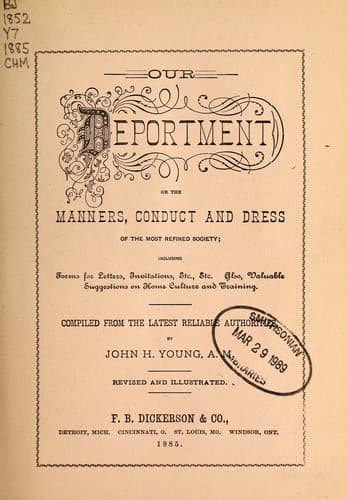
Our Deportment: Or the Manners, Conduct and Dress of the Most Refined SocietyYoung, John H.
General
Our Deportment: Or the Manners, Conduct and Dress of the Most Refined Society
Young, John H.
Etiquette
Children should not be prohibited from laughing and talking at the
table. Joyousness promotes the circulation of the blood, enlivens and
invigorates it, and sends it to all parts of the system, carrying with
it animation, vigor and life. Controversy should not be permitted at the
table, nor should any subjects which call forth political or religious
difference. Every topic introduced should be calculated to instruct,
interest or amuse. Business matters, past disappointments and mishaps
should not be alluded to, nor should bad news be spoken of at the table,
nor for half an hour before. All conversation should be of joyous and
gladsome character, such as will bring out pleasant remarks and
agreeable associations. Reproof should never be administered at the
table, either to a child or to a servant; no fault found with anything,
and no unkind word should be spoken. If remarks are to be made of absent
ones, they should be of a kind and charitable nature. Thus will the
family table be the center of pleasant memories in future years, when
the family shall have been scattered far and near, and some, perhaps,
have been laid in their final resting-place.
TRAIN CHILDREN FOR SOME OCCUPATION.
Chancellor Kent says: "Without some preparation made in youth for the
sequel of life, children of all conditions would probably become idle
and vicious when they grow up, from want of good instruction and habits,
and the means of subsistence, or from want of rational and useful
occupations. A parent who sends his son into the world without educating
him in some art, science, profession or business, does great injury to
mankind, as well as to his son and his own family, for he defrauds the
community of a useful citizen, and bequeaths to it a nuisance. That
parent who trains his child for some special occupation, who inspires
him with a feeling of genuine self-respect, has contributed a useful
citizen to society."
BAD TEMPER.
Dread an insubordinate temper, and deal with it as one of the greatest
evils. Let the child feel by your manner that he is not a safe companion
for the rest of the family when he is in anger. Allow no one to speak to
him at such times, not even to answer a question. Take from him books,
and whatever he may have, and place him where he shall feel that the
indulgence of a bad temper shall deprive him of all enjoyment, and he
will soon learn to control himself.
SELFISHNESS.
Selfishness that binds the miser in his chains, that chills the heart,
must never be allowed a place in the family circle. Teach the child to
share his gifts and pleasures with others, to be obliging, kind and
benevolent, and the influence of such instruction may come back into
your own bosom, to bless your latest hours.
HOME MAXIMS FOR TRAINING CHILDREN.
Public-domain text, read in full here on John Shaqi.
Reviews
Reviews
No reviews yet
Be the first to share your thoughts on this work.
Elsewhere in the archive
Join the Discussion
Join the discussion
Sign in to leave a comment or review.
Sign InorCreate an account