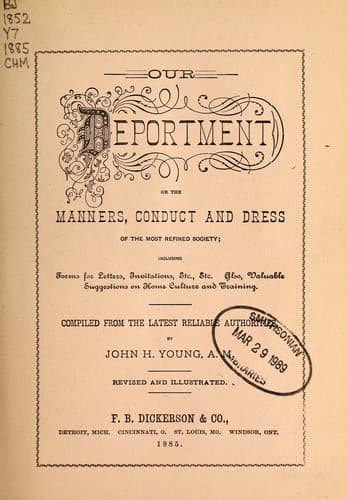
Our Deportment: Or the Manners, Conduct and Dress of the Most Refined SocietyYoung, John H.
General
Our Deportment: Or the Manners, Conduct and Dress of the Most Refined Society
Young, John H.
Etiquette
Remember that children are men and women in miniature, and though they
should be allowed to act as children, still our dealings with them
should be manly and not morose. Remember also that every word, tone and
gesture, nay, even your dress, makes an impression.
Never correct a child on suspicion, or without understanding the whole
matter, nor trifle with a child's feelings when under discipline.
Be always mild and cheerful in their presence, communicative, but never
extravagant, trifling or vulgar in language or gesture. Never trifle
with a child nor speak beseechingly when it is doing wrong.
Always follow commands with a close and careful watch, until the thing
is done, allowing no evasion and no modification, unless the child ask
for it, and it be expressly granted.
Never reprove children severely in company, nor hold them up to
ridicule, nor make light of their failings.
Never speak in an impatient, pitiful manner, if you have occasion to
find fault.
Never say to a child, "I don't believe what you say," nor even imply
your doubts. If you have such feelings, keep them to yourself and wait;
the truth will eventually be made plain.
Never disappoint the confidence a child places in you, whether it be a
thing placed in your care or a promise.
Always give prompt attention to a child when he speaks, so as to
prevent repeated calls, and that he may learn to give prompt attention
when you call him.
Never try to impress a child with religious truth when in anger, or talk
to him of God, as it will not have the desired effect. Do it under more
favorable circumstances.
At the table a child should be taught to sit up and behave in a becoming
manner, not to tease when denied, nor to leave his chair without asking.
A parent's wish at such time should be a law from which no appeal should
be made.
Even in sickness gentle restraint is better for a child than indulgence.
There should never be two sets of manners, the one for home and the
other for company, but a gentle behavior should be always required.
[Illustration]
[Illustration: MUSIC.
"A protection against vice,
An incentive to virtue."]
CHAPTER XX.
Home Culture.
The work of home culture should be made a matter of great importance to
every one, for upon it depends the happiness of earthly homes, as well
as our fitness for the enjoyment of the eternal home in heaven. The
sufferings endured here, friend for friend, parents for children,
unrequited sacrifices, cares and tears, all tend to discipline us, and
prepare us for the recompense which eternity brings.
CULTIVATE MORAL COURAGE.
Public-domain text, read in full here on John Shaqi.
Reviews
Reviews
No reviews yet
Be the first to share your thoughts on this work.
Elsewhere in the archive
Join the Discussion
Join the discussion
Sign in to leave a comment or review.
Sign InorCreate an account