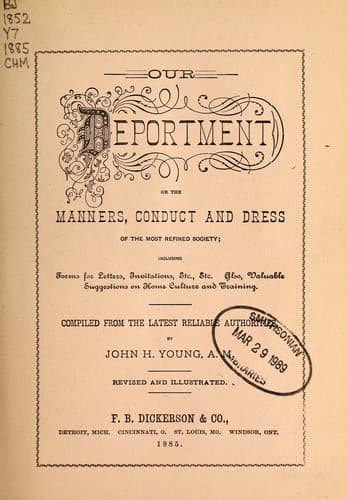
Our Deportment: Or the Manners, Conduct and Dress of the Most Refined SocietyYoung, John H.
General
Our Deportment: Or the Manners, Conduct and Dress of the Most Refined Society
Young, John H.
Etiquette
"Mr. and Mrs. Adam Brown regret that they cannot
accept Mrs. Smith's invitation for Wednesday
evening,"
is a rude form of regret.
"Mr. and Mrs. Adam Brown decline Mrs. Moses
Smith's invitation for Friday evening,"
is a still ruder form.
A curt and thoughtless reply is:
"Mr. and Mrs. Adam Brown's compliments and regrets
for Friday evening."
REASONS FOR REGRETS.
"All regrets from persons who are not able to accept invitations, should
contain a reason for regretting," is a rule strictly observed in our
best society, and is considered especially binding in answering a first
invitation. If persons are in mourning, they regret that a recent
bereavement prevents them from accepting. Those contemplating being
absent from home, regret that contemplated absence from home prevents
them from accepting. "A previous engagement" is made the excuse when
there is an engagement either at home or away from it, and also when one
has no inclination to accept; which makes it quite necessary for those
who really regret their inability to accept, to mention what that
engagement is.
THE FAMILY LETTER.
It seems hardly necessary to give the form of a letter from one member
of a family to another. It is often the case that letters sent from home
to an absent member are decidedly unsatisfactory, if not to a great
extent of little interest outside of one or two facts mentioned.
Consequently some hint as to what those letters should be, are here
given. They should be written as though the writer were talking, using
familiar expressions, and such peculiarities as the writer possesses in
ordinary speech should find a place in the letter. The writer may speak
of many trivial things at and about home, and gossipy matters in the
neighborhood, and should keep the absent one posted upon all minor facts
and occurrences, as well as the more important ones. The writer may make
inquiries as to how the absent one is enjoying himself, whether he finds
any place better than home, and ask such other questions as he may
desire, concluding with sincere expressions of affection from various
members of the family. The absent one may, in like manner, express
himself freely on all subjects, describe his journey minutely, and speak
of whatever he may feel deep interest in. In short, a family letter may
be as gossipy as the writer can make it, without much regard to an
attempt at showy or dignified composition.
THE LETTER OF FRIENDSHIP.
This should be of a more dignified tone, contain less trivialities than
the family letter, and should embrace matters that will be of interest
to both. A letter of friendship should be answered in due time,
according to the intimacy of the parties, but should not be delayed long
enough to allow the friendship to cool, if there is a desire to keep it
warm.
THE LOVE LETTER.
Public-domain text, read in full here on John Shaqi.
Reviews
Reviews
No reviews yet
Be the first to share your thoughts on this work.
Elsewhere in the archive
Join the Discussion
Join the discussion
Sign in to leave a comment or review.
Sign InorCreate an account