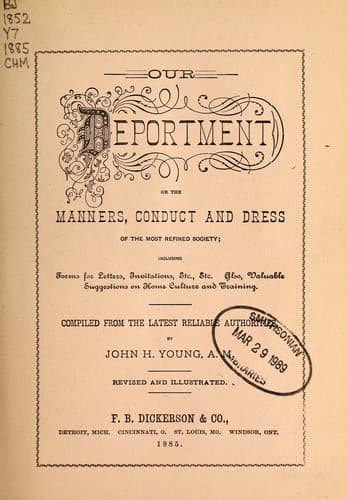
Our Deportment: Or the Manners, Conduct and Dress of the Most Refined SocietyYoung, John H.
General
Our Deportment: Or the Manners, Conduct and Dress of the Most Refined Society
Young, John H.
Etiquette
Emerson says: "Our tokens of love are for the most part barbarous, cold
and lifeless, because they do not represent our life. The only gift is a
portion of thyself. Therefore let the farmer give his corn; the miner
his gem; the sailor coral or shells; the painter his picture, and the
poet his poem." To persons of refined nature, whatever the friend
creates takes added value as part of themselves--part of their lives, as
it were, having gone into it. People of the highest rank, abroad, will
often accept, with gratitude, a bit of embroidery done by a friend, a
poem inscribed to them by an author; a painting executed by some artist;
who would not care for the most expensive bauble that was offered them.
Mere costliness does not constitute the soul of a present; it is the
kind feeling that it manifests which gives it its value. People who
possess noble natures do not make gifts where they feel neither
affection nor respect, but their gifts are bestowed out of the fullness
of kind hearts.
A present should be acknowledged without delay, but you must not follow
it quickly by a return. It is to be taken for granted that a gift is
intended to afford pleasure to the recipient, not to be regarded as a
question of investment or exchange. Never allude to a present you have
given, unless you have reason to believe that it has not been received
by the person to whom it was sent.
Unmarried ladies should not accept presents from gentlemen who are
neither related nor engaged to them, nor indebted to them for some
marked favors. A married lady may accept presents from a gentleman who
is indebted to her for hospitality.
In presenting a book to a friend, do not write in it the name of the
person to whom it is given. But this is a rule better honored in its
breach than in its observance, when the giver of the book is its author.
Presents made by a married lady to a gentleman, should be in the name of
both herself and her husband.
Never refuse a present if offered in kindness, unless the circumstances
are such that you cannot, with propriety, receive it. Nor, in receiving
a present, make such comments as would seem to indicate that your friend
cannot afford to make the present. On the other hand, never make a
present which you cannot afford to make. In that case the recipient, if
he or she knows anything of your circumstances, will think that you had
better kept it yourself.
GOVERNING OUR MOODS.
Public-domain text, read in full here on John Shaqi.
Reviews
Reviews
No reviews yet
Be the first to share your thoughts on this work.
Elsewhere in the archive
Join the Discussion
Join the discussion
Sign in to leave a comment or review.
Sign InorCreate an account