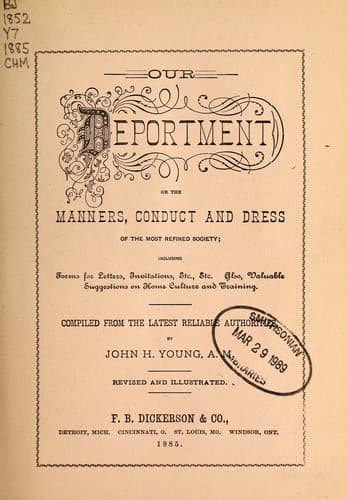
Our Deportment: Or the Manners, Conduct and Dress of the Most Refined SocietyYoung, John H.
General
Our Deportment: Or the Manners, Conduct and Dress of the Most Refined Society
Young, John H.
Etiquette
When writing to the different officials, the President is addressed "His
Excellency, the President of the United States;" the members of the
cabinet "The Honorable, the Secretary of State," etc., giving each his
proper title; the Vice-President, "The Honorable, the Vice-President of
the United States." In a ceremonious note, words must not be
abbreviated. In conversation the Speaker of the House of Representatives
is addressed as "Mr. Speaker;" a member of the cabinet as "Mr.
Secretary;" a senator as "Mr. Senator;" a member of the House of
Representatives as "Mister," unless he has some other title; but he is
introduced as "The Honorable Mr. Burrows, of Michigan." The custom is
becoming prevalent of addressing the wives of officials with the
prefixed titles of their husbands, as "Mrs. General Sherman," "Mrs.
Senator Thurman," "Mrs. Secretary Evarts."
THE FIRST TO VISIT.
The custom of first visits or calls at the capital is that residents
shall make the first call on strangers, and among the latter those
arriving first upon those coming later. Foreign ministers, however, in
order to make themselves known, call first upon the members of the
cabinet, which is returned.
SENATORS AND REPRESENTATIVES.
It is entirely optional with Senators, Representatives and all other
officials except the President and members of his cabinet, whether they
entertain. They act upon their own pleasure in the matter.
CHAPTER XXVIII.
Foreign Titles.
In this country, where everybody possesses one and the same title, that
of a citizen of this Republic, no one can claim a superiority of rank
and title. Not so in European countries, where the right of birth
entitles a person to honor, rank and title. And as our citizens are
constantly visiting foreign countries, it is well to understand
something of titles and ranks and their order of precedence.
ROYALTY.
In England, the king and queen are placed at the top of the social
structure. The mode by which they are addressed is in the form "Your
Majesty."
The Prince of Wales, the heir-apparent to the throne, stands second in
dignity. The other children are all known during their minority as
princes and princesses. The eldest princess is called the crown
princess. Upon their majority the younger sons have the title of duke
bestowed upon them, and the daughters retain that of princesses, adding
to it the title of their husbands. They are all designated as "Their
Royal Highnesses."
THE NOBILITY.
Public-domain text, read in full here on John Shaqi.
Reviews
Reviews
No reviews yet
Be the first to share your thoughts on this work.
Elsewhere in the archive
Join the Discussion
Join the discussion
Sign in to leave a comment or review.
Sign InorCreate an account