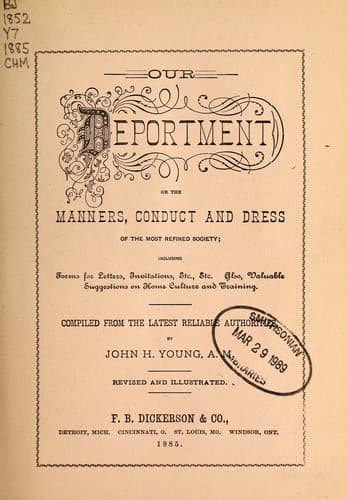
Our Deportment: Or the Manners, Conduct and Dress of the Most Refined SocietyYoung, John H.
General
Our Deportment: Or the Manners, Conduct and Dress of the Most Refined Society
Young, John H.
Etiquette
A duke who inherits the title from his father, stands one grade below a
royal duke. The wife of a duke is known as a duchess. They are both
addressed as "Your Grace." The eldest son is a marquis until he inherits
the higher title of his father. His wife is a marchioness. The younger
sons are lords by courtesy, and the daughters are distinguished by
having "Lady" prefixed to their Christian names. Earls and barons are
both spoken of as lords and their wives as ladies, though the latter are
by right respectively countesses and baronesses. The daughters of the
former are "ladies," the younger sons of both "honorables." The earl
occupies the higher position of the two in the peerage.
These complete the list of nobility, unless we include bishops, who are
lords in right of their ecclesiastical office, but whose title is not
hereditary.
All these are entitled to seats in the upper House of Parliament.
THE GENTRY.
Baronets are known as "Sirs," and their wives receive the title of
"Lady;" but they are only commoners of a higher degree, though there are
families who have borne their title for many successive generations who
would not exchange it for a recently created peerage.
A clergyman, by right of his calling, stands on an equality with all
commoners, a bishop with all peers.
ESQUIRE.
The title of Esquire, which is only an empty compliment in this country,
has special significance in England. The following in that country have
a legal right to the title:
The sons of peers, whether known in common conversation as lords or
honorables.
The eldest sons of peers' sons, and their eldest sons in perpetual
succession.
All the sons of baronets.
All esquires of the Knights of the Bath.
Lords of manors, chiefs of clans and other tenants of the crown _in
capite_ are esquires by prescription.
Esquires created to that rank by patent, and their eldest sons in
perpetual succession.
Esquires by office, such as justices of the peace while on the roll,
mayors of towns during mayoralty, and sheriffs of counties (who retain
the title for life).
Members of the House of Commons.
Barristers-at-law.
Bachelors of divinity, law and physic.
All who in commissions signed by the sovereign, are ever styled esquires
retain that designation for life.
IMPERIAL RANK.
Emperors and empresses rank higher than kings. The sons and daughters of
the emperor of Austria are called archdukes and archduchesses, the
names being handed down from the time when the ruler of that country
claimed for himself no higher title than that of archduke. The emperor
of Russia is known as the czar, the name being identical with the Roman
caesar and the German kaiser. The heir-apparent to the Russian throne is
the czarowitch.
EUROPEAN TITLES.
Public-domain text, read in full here on John Shaqi.
Our Deportment: Or the Manners, Conduct and Dress of the Most Refined Society — John Shaqi
Reviews
Reviews
No reviews yet
Be the first to share your thoughts on this work.
Elsewhere in the archive
Join the Discussion
Join the discussion
Sign in to leave a comment or review.
Sign InorCreate an account