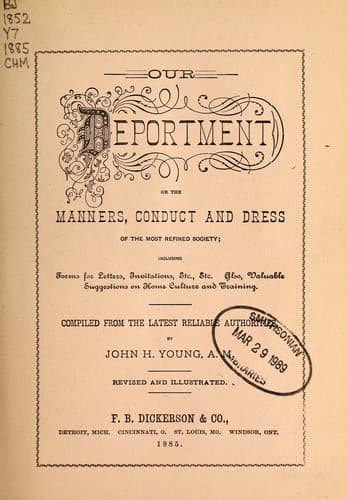
Our Deportment: Or the Manners, Conduct and Dress of the Most Refined SocietyYoung, John H.
General
Our Deportment: Or the Manners, Conduct and Dress of the Most Refined Society
Young, John H.
Etiquette
It is important for the young man learning business, or just getting a
start in business, to form correct habits, and especially of forming the
habit of being polite to all with whom he has business relations,
showing the same courteous treatment to men or women, poorly or plainly
dressed, as though they were attired in the most costly of garments. A
man who forms habits of politeness and gentlemanly treatment of
everybody in early life, has acquired the good-will of all with whom he
has ever been brought into social or business relations. He should also
guard against such habits as profanity, the use of tobacco and
intoxicating liquors, if he would gain and retain the respect of the
best portion of the community, and should, if possible, cultivate the
habit of being cheerful at all times and in all places.
KEEP YOUR TEMPER.
In discussing business matters, never lose your temper, even though your
opponent in a controversy should become angry, and in the heat of
discussion make rude and disagreeable remarks and charges. By a calm and
dignified bearing and courteous treatment you will conquer his rudeness.
HONESTY THE BEST POLICY.
"Honesty is the best policy," is a maxim which merchants and tradesmen
will find as true as it is trite, and no tradesman who wishes to retain
his customers and his reputation will knowingly misrepresent the quality
of his goods. It is not good policy for a merchant or clerk, in selling
goods, to tell the customer what they cost, as, in a majority of cases,
he will not be believed.
THE EXAMPLE OF A MERCHANT PRINCE.
The value of politeness to a merchant is nowhere more clearly shown than
in the case of the late A.T. Stewart, the merchant prince of New York.
He not only treated every customer he waited upon with the utmost
courtesy, but he demanded it of every employe, and sought for men
possessing every quality of character tending to secure this suavity of
manner, in the selection of his salesmen and clerks. He required them to
observe rigidly all rules and forms of politeness, and would allow no
partiality shown to people on account of their dress, those clad in
humble apparel being treated with the same affability and politeness as
those richly dressed. Everybody who entered his store was sure of
receiving kind and courteous treatment. This may, or may not, have been
his secret of success, but it certainly gained and retained for him a
large custom, and was one element in his character which can be highly
commended. And every merchant will be judged of by his customers in
proportion to the courteous treatment they receive from him, or from
clerks in his store. The lawyer or the doctor will also acquire
popularity and patronage as he exhibits courteous and kind treatment to
all with whom he comes into social or business relations.
BREAKING AN APPOINTMENT.
Public-domain text, read in full here on John Shaqi.
Reviews
Reviews
No reviews yet
Be the first to share your thoughts on this work.
Elsewhere in the archive
Join the Discussion
Join the discussion
Sign in to leave a comment or review.
Sign InorCreate an account