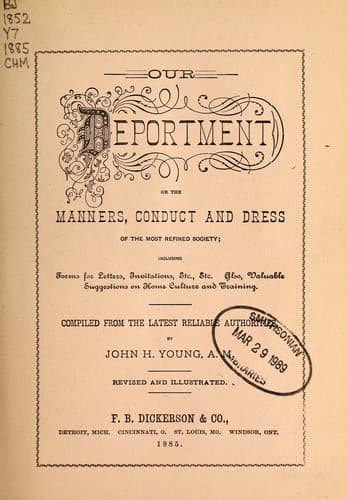
Our Deportment: Or the Manners, Conduct and Dress of the Most Refined SocietyYoung, John H.
General
Our Deportment: Or the Manners, Conduct and Dress of the Most Refined Society
Young, John H.
Etiquette
Directions at what gate to enter and where the carriages are to stop are
always printed in the newspapers. These directions apply with equal
force to ladies and to gentlemen.
The person to be presented must provide himself or herself with a court
costume, which for men consists partly of knee-breeches and hose, for
women of an ample court train. These costumes are indispensable, and can
be hired for the occasion.
THE PRESENTATION.
It is desirable to be early to escape the crowd. When the lady leaves
her carriage, she must leave everything in the shape of a cloak or scarf
behind her. Her train must be carefully folded over her left arm as she
enters the long gallery of St. James, where she waits her turn for
presentation.
The lady is at length ushered into the presence-chamber, which is
entered by two doors. She goes in at the one indicated to her, dropping
her train as she passes the threshold, which train is instantly spread
out by the wands of the lords-in-waiting. The lady then walks forward
towards the sovereign or the person who represents the sovereign. The
card on which her name is inscribed is then handed to another
lord-in-waiting, who reads the name aloud. When she arrives just before
His or Her Majesty, she should courtesy as low as possible, so as to
almost kneel.
If the lady presented be a peeress or a peer's daughter, the queen
kisses her on the forehead. If only a commoner, then the queen extends
her hand to be kissed by the lady presented, who, having done so, rises,
courtesies to each of the other members of the royal family present, and
then passes on. She must keep her face turned toward the sovereign as
she passes to and through the door leading from the presence-chamber.
[Illustration]
CHAPTER XXIX.
Business.
In the chapter on "Our Manners," we have spoken of the importance of
civility and politeness as a means of success to the business and
professional man. It is in the ordinary walks of life, in the most
trivial affairs that a man's real character is shown, and consequently
every man, whatever may be his calling, will do well to give due
attention to those trivial affairs which, in his daily association with
men of the world, will give him a reputation of being cold, austere, and
unapproachable, or warm-hearted, genial, and sympathetic.
FORM GOOD HABITS.
Public-domain text, read in full here on John Shaqi.
Reviews
Reviews
No reviews yet
Be the first to share your thoughts on this work.
Elsewhere in the archive
Join the Discussion
Join the discussion
Sign in to leave a comment or review.
Sign InorCreate an account