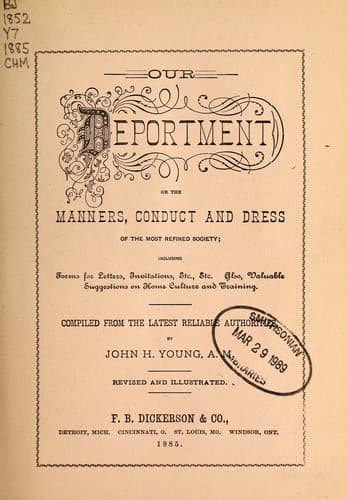
Our Deportment: Or the Manners, Conduct and Dress of the Most Refined SocietyYoung, John H.
General
Our Deportment: Or the Manners, Conduct and Dress of the Most Refined Society
Young, John H.
Etiquette
It is said: "A bow is a note drawn at sight. You are bound to
acknowledge it immediately, and to the full amount." It should be
respectful, cordial, civil or familiar, according to circumstances.
Between gentlemen, an inclination of the head, a gesture of the hand, or
the mere touching of the hat is sufficient; but in bowing to a lady, the
hat must be lifted from the head. If you know people slightly, you
recognize them slightly; if you know them well, you bow with more
familiarity. The body is not bent at all in bowing; the inclination of
the head is all that is necessary.
If the gentleman is smoking, he withdraws his cigar from his mouth
before lifting his hat to a lady, or if he should happen to have his
hand in his pocket he removes it.
At the moment of the first meeting of the eyes of an acquaintance you
bow. Any one who has been introduced to you, or any one to whom you have
been introduced, is entitled to this mark of respect.
The bow is the touchstone of good breeding, and to neglect it, even to
one with whom you may have a trifling difference, shows deficiency in
cultivation and in the instincts of refinement. A bow does not entail a
calling acquaintance. Its entire neglect reveals the character and
training of the person; the manner of its observance reveals the very
shades of breeding that exist between the ill-bred and the well-bred.
RETURNING A BOW.
A gentleman walking with a lady returns a bow made to her, whether by a
lady or gentleman (lifting his hat not too far from his head), although
the one bowing is an entire stranger to him.
It is civility to return a bow, although you do not know the one who is
bowing to you. Either the one who bows, knows you, or has mistaken you
for some one else. In either case you should return the bow, and
probably the mistake will be discovered to have occurred for want of
quick recognition on your own part, or from some resemblance that you
bear to another.
THE MANNER OF BOWING.
The manner in which the salutation of recognition is made, may be
regarded as an unerring test of the breeding, training, or culture of a
person. It should be prompt as soon as the eyes meet, whether on the
street or in a room. The intercourse need go no further, but that bow
must be made. There are but few laws which have better reasons for their
observance than this. This rule holds good under all circumstances,
whether within doors or without. Those who abstain from bowing at one
time, and bow at another, should not be surprised to find that the
person whom they have neglected, has avoided the continuation of their
acquaintance.
DUTIES OF YOUNG TO OLDER PEOPLE.
Public-domain text, read in full here on John Shaqi.
Reviews
Reviews
No reviews yet
Be the first to share your thoughts on this work.
Join the Discussion
Join the discussion
Sign in to leave a comment or review.
Sign InorCreate an account