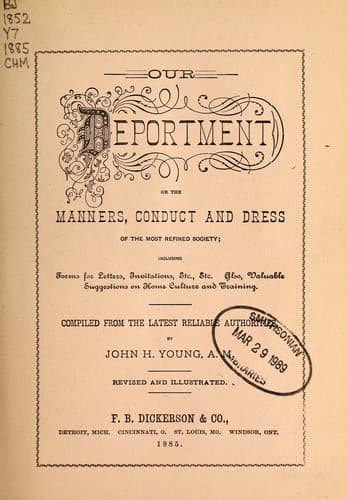
Our Deportment: Or the Manners, Conduct and Dress of the Most Refined SocietyYoung, John H.
General
Our Deportment: Or the Manners, Conduct and Dress of the Most Refined Society
Young, John H.
Etiquette
Strangers arriving are expected to send their cards to their
acquaintances, bearing their direction, as an announcement that they are
in the city. This rule is often neglected, but, unless it is observed,
strangers may be a long time in town without their presence being known.
RETURNING A FIRST CALL.
A first call ought to be returned within three or four days. A longer
delay than a week is considered an intimation that you are unwilling to
accept the new acquaintance, unless some excuse for the remissness is
made.
FORMING ACQUAINTANCE.
In an event of exchange of calls between two ladies, without meeting,
who are known to each other only by sight, they should upon the first
opportunity, make themselves acquainted with one another. The younger
should seek the older, or the one who has been the recipient of the
first attention should introduce herself, or seek an introduction, but
it is not necessary to stand upon ceremony on such points. Ladies
knowing each other by sight, bow, after an exchange of cards.
THE FIRST CALL.
When it becomes a question as to who shall call first, between old
residents, the older should take the initiatory. Ladies, who have been
in the habit of meeting for sometime without exchanging calls, sometimes
say to each other: "I hope you will come and see me!" and often the
answer is made: "Oh, you must come and see me first!" That answer could
only be given, with propriety, by a lady who is much the older of the
two. The lady who extends the invitation makes the first advance, and
the one who receives it should at least say: "I thank you--you are very
kind," and then accept the invitation or not, as it pleases her. It is
the custom for residents to make the first call upon strangers.
CALLS OF CONGRATULATION.
Calls of congratulation are made when any happy or auspicious event may
have occurred in the family visited--such as a birth, marriage, or any
piece of good fortune. Such visits may be made either similar to the
morning or the evening call. Such visits may also be made upon the
appointment of friends to any important office or honored position, or
when a friend has distinguished himself by a notable public address or
oration.
P.P.C. CALLS.
When persons are going abroad to be absent for a considerable period, if
they have not time or inclination to take leave of all their friends by
making formal calls, they will send to each of their friends a card with
the letters P.P.C. written upon it. They are the initials of "Pour
Prendre Conge"--to take leave--and may with propriety stand for
"presents parting compliments." On returning home, it is customary that
friends should first call upon them. A neglect to do so, unless for
some good excuse, is sufficient cause to drop their acquaintance. In
taking leave of a family, you send as many cards as you would if you
were paying an ordinary visit.
VISITS OF CONDOLENCE.
Public-domain text, read in full here on John Shaqi.
Reviews
Reviews
No reviews yet
Be the first to share your thoughts on this work.
Join the Discussion
Join the discussion
Sign in to leave a comment or review.
Sign InorCreate an account