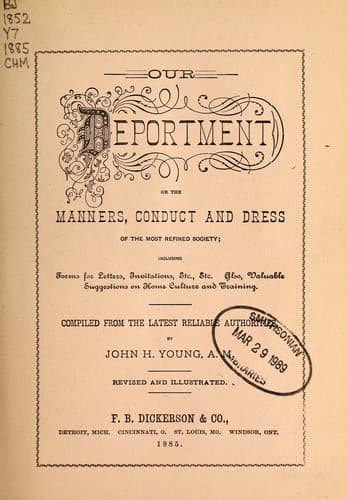
Our Deportment: Or the Manners, Conduct and Dress of the Most Refined SocietyYoung, John H.
General
Our Deportment: Or the Manners, Conduct and Dress of the Most Refined Society
Young, John H.
Etiquette
For one or two persons to monopolize a conversation which ought to be
general, is exceedingly rude. If the dinner party is a large one, you
may converse with those near you, raising the voice only loud enough to
be distinctly heard by the persons you are talking with.
PICKING TEETH AT THE TABLE.
It is a mark of rudeness to pick your teeth at the table, and it should
always be avoided. To hold your hand or napkin over your mouth does not
avoid the rudeness of the act, but if it becomes a matter of necessity
to remove some obstacle from between the teeth, then your open mouth
should be concealed by your hand or napkin.
SELECTING A PARTICULAR DISH.
Never express a preference for any dish or any particular portion of a
fowl or of meat, unless requested to do so, and then answer promptly,
that no time may be wasted in serving you and others after you.
DUTIES OF HOSTESS AND HOST.
Tact and self-possession are demanded of the hostess, in order that she
may perform her duties agreeably, which are not onerous. She should
instruct her servants not to remove her plate until her guests have
finished. If she speaks of any omission by which her servants have
inconvenienced her guests, she must do it with dignity, not betraying
any undue annoyance. She must put all her guests at their ease, and pay
every possible attention to the requirements of each and all around her.
No accident must disturb her; no disappointment embarrass her. If her
precious china and her rare glass are broken before her eyes, she must
seem to take but little or no notice of it.
The host must aid the hostess in her efforts. He should have ease and
frankness of manner, a calmness of temper that nothing can ruffle, and a
kindness of disposition that can never be exhausted. He must encourage
the timid, draw out the silent and direct conversation rather than
sustain it himself.
No matter what may go wrong, a hostess should never seem to notice it to
the annoyance of her guests. By passing it over herself, it will very
frequently escape the attention of others. If her guests arrive late,
she should welcome them as cordially as if they had come early, but she
will commit a rudeness to those who have arrived punctually, if she
awaits dinner for tardy guests for more than the fifteen minutes of
grace prescribed by custom.
RETIRING FROM THE TABLE.
When the hostess sees that all have finished, she looks at the lady who
is sitting at the right of the host, and the company rise, and withdraw
in the order they are seated, without precedence. After retiring to the
drawing-room, the guests should intermingle in a social manner. It is
expected that the guests will remain from one to three hours after
dinner.
ACCEPTING HOSPITALITY A SIGN OF GOOD-WILL.
Public-domain text, read in full here on John Shaqi.
Reviews
Reviews
No reviews yet
Be the first to share your thoughts on this work.
Elsewhere in the archive
Join the Discussion
Join the discussion
Sign in to leave a comment or review.
Sign InorCreate an account