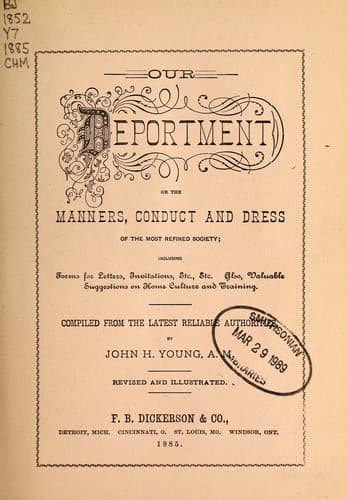
Our Deportment: Or the Manners, Conduct and Dress of the Most Refined SocietyYoung, John H.
General
Our Deportment: Or the Manners, Conduct and Dress of the Most Refined Society
Young, John H.
Etiquette
At the first meal of the day, even in the most orderly households, an
amount of freedom is allowed, which would be unjustifiable at any other
meal. The head of the house may look over his morning paper, and the
various other members may glance over correspondence or such books or
studies as they are interested in. Each may rise and leave the table
when business or pleasure dictates, without awaiting for the others or
for a general signal.
The breakfast table should be simply decorated, yet it may be made very
attractive with its snowy cloth and napkins, its array of glass, and its
ornamentation of fruits and flowers. Bread should be placed upon the
table, cut in slices. In eating, it must always be broken, never cut,
and certainly not bitten. Fruit should be served in abundance at
breakfast whenever practicable. There is an old adage which declares
that "fruit is gold in the morning, silver at noon, and lead at night."
LUNCHEON.
In many of our large cities, where business prevents the head of the
family from returning to dinner until a late hour, luncheon is served
about midday and serves as an early dinner for children and servants.
There is much less formality in the serving of lunch than of dinner. It
is all placed upon the table at once, whether it consists of one or more
courses. Where only one or two are at luncheon, the repast is ordinarily
served on a tray.
DINNER.
The private family dinner should be the social hour of the day. Then
parents and children should meet together, and the meal should be of
such length as to admit of the greatest sociality. It is an old saying
that chatted food is half digested. The utmost good feeling should
prevail among all. Business and domestic cares and troubles should be,
for the time, forgotten, and the pleasures of home most heartily
enjoyed. In another chapter we have spoken at length upon fashionable
dinner parties.
THE KNIFE AND FORK.
The knife and fork were not made for playthings, and should not be used
as such when people are waiting at the table for the food to be served.
Do not hold them erect in your hands at each side of your plate, nor
cross them on your plate when you have finished, nor make a noise with
them. The knife should only be used for cutting meats and hard
substances, while the fork, held in the left hand, is used in carrying
food into the mouth. A knife must never, on any account, be put into the
mouth. When you send your plate to be refilled, do not send your knife
and fork, but put them upon a piece of bread, or hold them in your hand.
GREEDINESS.
Public-domain text, read in full here on John Shaqi.
Reviews
Reviews
No reviews yet
Be the first to share your thoughts on this work.
Elsewhere in the archive
Join the Discussion
Join the discussion
Sign in to leave a comment or review.
Sign InorCreate an account