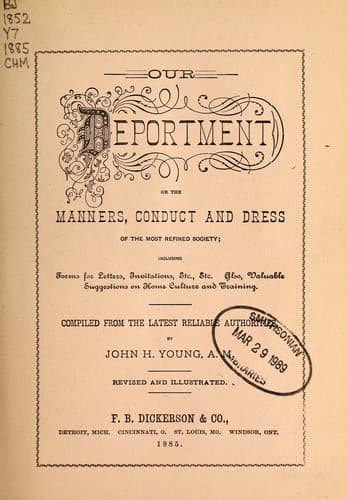
Our Deportment: Or the Manners, Conduct and Dress of the Most Refined SocietyYoung, John H.
General
Our Deportment: Or the Manners, Conduct and Dress of the Most Refined Society
Young, John H.
Etiquette
If the guests should include one or more people of well-known temperance
principles, in deference to the scruples of these guests, wines or
liquors should not be brought to the table. People who entertain should
also be cautious as to serving wines at all. It is impossible to tell
what harm you may do to some of your highly esteemed guests. It may be
that your palatable wines may create an appetite for the habitual use of
wines or stronger alcoholic liquors; or you may renew a passion long
controlled and entombed; or you may turn a wavering will from a
seemingly steadfast resolution to forever abstain. This is an age of
reforms, the temperance reform being by no means the least powerful of
these, and no ladies or gentlemen will be censured or misunderstood if
they neglect to supply their dinner table with any kind of intoxicating
liquor. Mrs. ex-President Hayes banished wines and liquors from her
table, and an example set by the "first lady of the land" can be safely
followed in every American household, whatever may have been former
prevailing customs. It is safe to say that no "mistress of the White
House" will ever set aside the temperance principles established by Mrs.
Hayes.
[Illustration]
CHAPTER X.
Table Manners and Etiquette.
It is of the highest importance that all persons should conduct
themselves with the strictest regard to good breeding, even in the
privacy of their own homes, when at table, a neglect of such observances
will render one stiff and awkward in society. There are so many little
points to be observed, that unless a person is habitually accustomed to
observe them, he unconsciously commits some error, or will appear
awkward and constrained upon occasions when it is important to be fully
at ease. To be thoroughly at ease at such times is only acquired by the
habitual practice of good manners at the table, and is the result of
proper home training. It is the duty of parents to accustom their
children, by example as well as by precept, to be attentive and polite
to each other at every meal, as well as to observe proper rules of
etiquette, and if they do so, they need never fear that they will be
rude or awkward when they go abroad. Even when persons habitually eat
alone, they should pay due regard to the rules of etiquette, for by so
doing they form habits of ease and gracefulness which are requisite in
refined circles; otherwise they speedily acquire rude and awkward habits
which they cannot shake off without great difficulty, and which are at
times embarrassing to themselves and their friends. In private families
it should be observed as a rule to meet together at all meals of the day
around one common table, where the same rules of etiquette should be
rigidly enforced, as though each member of the family were sitting at a
stranger's table. It is only by this constant practice of the rules of
good behaviour at home, that good manners become easy when any of them
go abroad.
THE BREAKFAST.
Public-domain text, read in full here on John Shaqi.
Reviews
Reviews
No reviews yet
Be the first to share your thoughts on this work.
Elsewhere in the archive
Join the Discussion
Join the discussion
Sign in to leave a comment or review.
Sign InorCreate an account