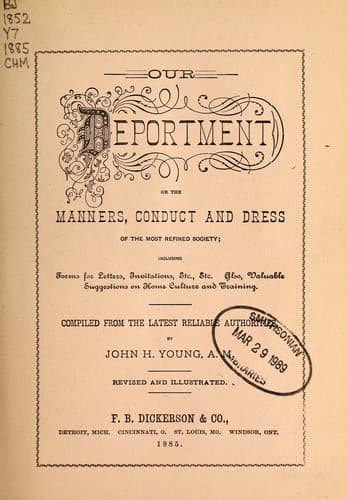
Our Deportment: Or the Manners, Conduct and Dress of the Most Refined SocietyYoung, John H.
General
Our Deportment: Or the Manners, Conduct and Dress of the Most Refined Society
Young, John H.
Etiquette
The requisites for a successful ball are good music and plenty of people
to dance. An English writer says, "The advantage of the ball is, that it
brings young people together for a sensible and innocent recreation, and
takes them away from silly, if not from bad ones; that it gives them
exercise, and that the general effect of the beauty, elegance and
brilliancy of a ball is to elevate rather than to deprave the mind." It
may be that the round dance is monopolizing the ball room to a too great
extent, and it is possible that these may be so frequent as to mar the
pleasure of some persons who do not care to participate in them, to the
exclusion of "square" and other dances. America should not be the only
nation that confines ball room dancing to waltzes, as is done in some of
our cities. There should be an equal number of waltzes and quadrilles,
with one or two contra dances, which would give an opportunity to those
who object (or whose parents object) to round dances to appear on the
floor.
PREPARATIONS FOR A BALL.
There should be dressing-rooms for ladies and gentlemen, with a servant
or servants to each. There should be cards with the names of the invited
guests upon them, or checks with duplicates to be given to the guests
ready to pin upon the wraps of each one. Each dressing-room should be
supplied with a complete set of toilet articles. It is customary to
decorate the house elaborately with flowers. Although this is an
expensive luxury, it adds much to beautifying the rooms.
THE MUSIC.
Four musicians are enough for a "dance." When the dancing room is small,
the flageolet is preferable to the horn, as it is less noisy and marks
the time as well. The piano and violin form the mainstay of the band;
but when the rooms are large enough, a larger band may be employed.
THE DANCES.
The dances should be arranged beforehand, and for large balls programmes
are printed with a list of the dances. Usually a ball opens with a
waltz, followed by a quadrille, and these are succeeded by galops,
lancers, polkas, quadrilles and waltzes in turn.
INTRODUCTIONS AT A BALL.
Public-domain text, read in full here on John Shaqi.
Reviews
Reviews
No reviews yet
Be the first to share your thoughts on this work.
Elsewhere in the archive
Join the Discussion
Join the discussion
Sign in to leave a comment or review.
Sign InorCreate an account