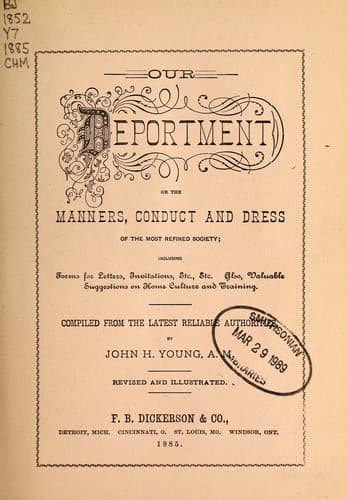
Our Deportment: Or the Manners, Conduct and Dress of the Most Refined SocietyYoung, John H.
General
Our Deportment: Or the Manners, Conduct and Dress of the Most Refined Society
Young, John H.
Etiquette
Gentlemen who are introduced to ladies at a ball, solely for the purpose
of dancing, wait to be recognized before speaking with ladies upon
meeting afterwards, but they are at liberty to recall themselves by
lifting their hats in passing. In England a ball-room acquaintance
rarely goes any farther, until they have met at more balls than one; so,
also, a gentleman cannot, after being introduced to a young lady, ask
her for more than two dances during the same evening. In England an
introduction given for dancing purposes does not constitute
acquaintanceship. With us, as in Continental Europe, it does. It is for
this reason that, in England, ladies are expected to bow first, while on
the Continent it is the gentlemen who give the first marks of
recognition, as it should be here, or better still, simultaneously, when
the recognition is simultaneous. It is as much the gentleman's place to
bow (with our mode of life) as it is the lady's. The one who recognizes
first should be the first to show that recognition. Introductions take
place in a ball room in order to provide ladies with partners, or
between persons residing in different cities. In all other cases
permission is asked before giving introductions. But where a hostess is
sufficiently discriminating in the selection of her guests, those
assembled under her roof should remember that they are, in a certain
sense, made known to one another, and ought, therefore, to be able to
converse freely without introductions.
RECEIVING GUESTS.
The custom of the host and hostess receiving together, is not now
prevalent. The receiving devolves upon the hostess, but it is the duty
of the host to remain within sight until after the arrivals are
principally over, that he may be easily found by any one seeking him.
The same duty devolves upon the sons, who, that evening, must share
their attentions with all. The daughters, as well as the sons, will look
after partners for the young ladies who desire to dance, and they will
try to see that no one is neglected before they join the dancers
themselves.
AN AFTER-CALL.
After a ball, an after-call is due the lady of the house at which you
were entertained, and should be made as soon as convenient--within two
weeks at the farthest. The call loses its significance entirely, and
passes into remissness, when a longer time is permitted to elapse. If it
is not possible to make a call, send your card or leave it at the door.
It has become customary of late for a lady who has no weekly reception
day, in sending invitations to a ball, to inclose her card in each
invitation for one or more receptions, in order that the after-calls
due her may be made on that day.
SUPPER.
Public-domain text, read in full here on John Shaqi.
Reviews
Reviews
No reviews yet
Be the first to share your thoughts on this work.
Elsewhere in the archive
Join the Discussion
Join the discussion
Sign in to leave a comment or review.
Sign InorCreate an account